
What is E-Assessment in Income Tax
E-Assessment is a faceless digital income tax assessment system implemented by India’s Income Tax Department, in which all inspection, notices, document verification, and final assessment are completed electronically with no physical touch between taxpayer and officer.
It operates under the Faceless Assessment Scheme, which is administered by the National Faceless Assessment Centre.
What is E-Assessment
E-Assessment is a sophisticated digital taxation system implemented under Section 144B of the Income Tax Act of 1961. It replaces traditional manual assessments with a completely online and automated method.
Under this technique, taxpayers and income tax officers do not interact physically. All contact occurs through the Income Tax e-filing site.
This effort is part of India’s Digital Taxation Reform, which aims to improve transparency, reduce corruption, and streamline tax administration.
How E-Assessment Works in India (2026)
- The income tax department system automatically selects cases.
- The case is sent to the National Faceless Assessment Centre.
- NFAC sends notices to taxpayers using the income tax e-filing system.
- Taxpayers submit their responses and documentation online.
- The Assessment Unit (AU) is reviewing the case.
- Technical and verification units aid in the inspection of data and records
- A draft assessment order is created and digitally evaluated.
- The final evaluation order is issued electronically without personal interaction.
Key Features of E-Assessment System (India 2026)
- Completely computerized and paperless evaluation procedure
- No physical interaction between the taxpayer and the income tax official.
- Managed centrally by NFAC (National Faceless Assessment Centre).
- Automated case selection and allocation system.
- Secure document upload and communication using the income tax e-filing system.
- Multi-layer review system (Assessment Unit, Technical Unit, and Review Unit).
- Standardized and uniform method for all taxpayers in India
- Transparent system with lower potential of prejudice and corruption.
Advantages of E-Assessment in India
1. Transparent Tax System
E-assessment eliminates direct connection between taxpayers and income tax officials, considerably reducing the possibility of prejudice, influence, or corruption. All alerts, responses, and judgments are handled through a digital system, so every action is documented and traceable, guaranteeing total openness in the evaluation process.
2. Faster Case Processing
The automated E-Assessment system facilitates case allocation and processing without manual delays. This minimizes the overall time required for examination and assessment, making the income tax system more efficient and results-driven.
3. Convenience for taxpayers.
Taxpayers may conveniently reply to notifications, add documents, and check case status online via the income tax e-filing system. This eliminates the need to physically visit tax authorities and facilitates compliance.
4. Reduced Human Error
Because the whole process is handled digitally, the possibility of human error in data entry, computation, or interpretation is greatly eliminated. This leads to more accurate and dependable evaluation results.
5. Improved accountability.
Each case is reviewed by many separate units, including the Assessment Unit, Technical Unit, and Review Unit, before a final judgment is reached. This tiered review approach promotes more responsibility and decreases the likelihood of unjust assessment.
6. Uniform Tax Procedure Across India
E-Assessment is conducted using a centralized system administered by NFAC, guaranteeing that the same rules and processes are followed equally to all taxpayers in India. This eliminates geographical disparities and provides equitable treatment for everybody.
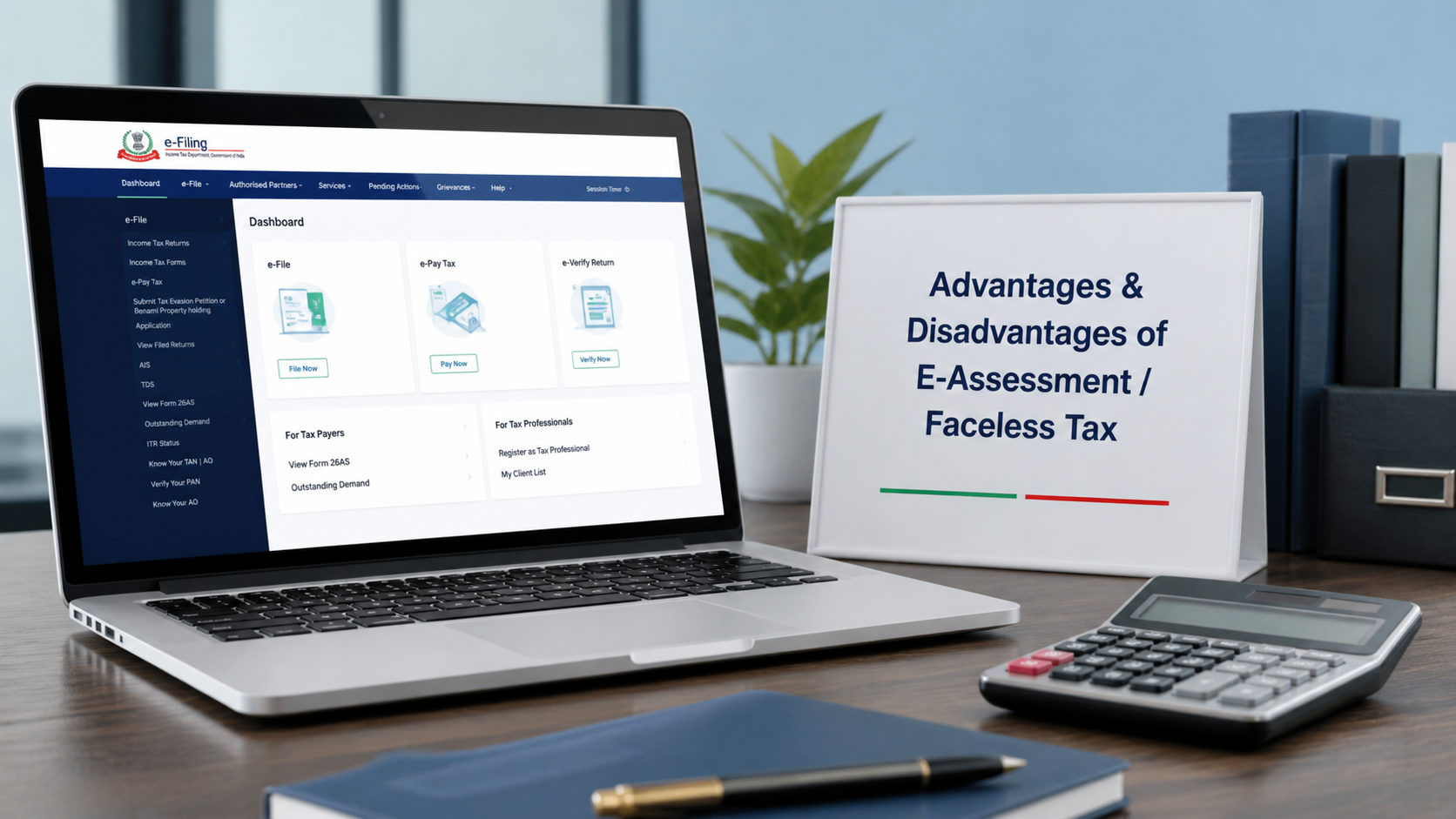
Disadvantages of E-Assessment in India
1. Technical issues and portal errors.
E-Assessment is completely reliant on the online income tax site, which occasionally experiences server unavailability, delayed loading, or technical difficulties. These difficulties might cause delays in document submission and response filing, particularly during high filing times.
2. Internet Dependency.
A reliable internet connection is required to access the e-filing platform and submit replies. Poor connectivity in rural or underserved locations might make it difficult to comply on time.
3. Lack of Personal Interaction.
Because the system is faceless, taxpayers cannot meet with or explain their case to an assessing official. In complex instances, a lack of clear communication might lead to misconceptions.
4. Document Upload Limitations
The portal’s file size and format constraints make it difficult for enterprises to post significant financial statements or extensive supporting documents in one go.
5. Misinterpretation of Information.
Because communication is completely digital, evaluating units may occasionally misinterpret given data or documents owing to a lack of vocal explanation, resulting in superfluous inquiry.
6. Low Awareness Among Taxpayers
Many small taxpayers and companies are still unaware of how the e-assessment system operates. This lack of expertise might cause mistakes in reacting to alerts.
7. Dependence on technology
Because the entire system is based on technology, any software fault, cyber risk, or system failure might cause a temporary disruption in the evaluation process.
Importance of E-Assessment in India
- Increases transparency in the income tax assessment process by eliminating direct human involvement.
- Reduces corruption and unfair practices with a completely faceless system.
- Automated processing speeds up tax assessments and decisions.
- Supports the Digital India vision by making taxation completely online and paperless.
- Ensures standard tax regulations and processes for all taxpayers in India.
- Improves the efficiency of the Income Tax Department through centralized processing (NFAC).
- Promotes higher tax compliance among people and companies.
- Reduces paperwork to save time, money, and administrative effort.
How Sharda Associates Helps in E-Assessment Cases
- Helps taxpayers understand and respond to income tax notices under E-Assessment system
- Assists in preparing accurate replies and uploading required documents on the portal
- Provides expert support in handling scrutiny and NFAC assessment cases
- Ensures proper compliance with income tax rules to avoid penalties or errors
- Guides in organizing financial records and reports for smooth assessment process
Need expert help with your E-Assessment notice? Contact Sharda Associates today for professional tax support and hassle-free resolution.
Frequently Asked Questions
Q1. What precisely is the E-Assessment system in terms of Indian income tax?
E-Assessment is a digital, faceless procedure in which tax inspections and document verifications are carried out electronically via the e-filing site, removing the taxpayer’s physical involvement with the tax department.
Q2. Which authority in India manages the faceless E-Assessment process?
The National Faceless Assessment Centre (NFAC) oversees the entire procedure. It acts as a single point of contact for the taxpayer and the many specialist internal assessment divisions.
Q3. How does the Income Tax Department pick certain instances for E-Assessment?
Cases are automatically picked by a computerized system based on data analytics and risk management factors, enabling a non-discretionary and unbiased method to select taxpayers for comprehensive examination or evaluation.
Q4. Which precise clause of the Income Tax Act governs E-Assessment?
The E-Assessment system is principally based on Section 144B of the Income Tax Act of 1961, which establishes the legislative basis for the Faceless Assessment Scheme and its automated operations.
Q5. Which three specialist units support the NFAC during an assessment?
The procedure includes the Assessment Unit (to detect concerns), the Verification Unit (to cross-check data), and the Technical Unit (to provide legal or IT assistance), resulting in a multi-layered review system.
Q6: How does a taxpayer get alerts and submit paperwork in this faceless system?
Notices are sent electronically to the taxpayer’s registered account on the e-filing system. Responses and supporting evidence must be uploaded digitally in the appropriate formats using the same platform.
Q7. What is the main benefit of the faceless character of E-Assessment?
It dramatically enhances transparency and decreases corruption by eliminating direct human touch. This guarantees that evaluations are only based on merit and recorded data, rather than personal influence or bias.
Q8. How does the E-Assessment system help to speed up the processing of tax cases?
By employing automated case allocation and a centralized digital workflow, the system eliminates manual logistical delays, allowing for faster reviews, draft orders, and assessment process completion.