
MSME Contribution to Indian Economy
Micro, Small, and Medium Enterprises (MSMEs) are considered as the backbone of India’s economy. They have an important role in economic development, job creation, and industrial expansion. Whether you are starting a business or submitting a project report for a bank loan, recognizing the relevance of MSMEs is critical.
In this extensive guide, we will discuss the significance of MSME in India, their contribution to the economy, advantages, and the role of project financing in MSME development.
What is MSME?
MSME stands for Micro, Small, and Medium Enterprises. These enterprises are grouped according to their investment and yearly turnover.
1. Micro enterprises can invest up to ₹1 crore and generate up to ₹5 crore in revenue.
2. Small enterprises can invest up to ₹10 crore and generate up to ₹50 crore in sales.
3. Medium enterprises can invest up to ₹50 crore and generate up to ₹250 crore in sales.
4. Manufacturing companies, service providers, entrepreneurs, and small merchants are all examples of MSMEs.
Importance of MSME in India
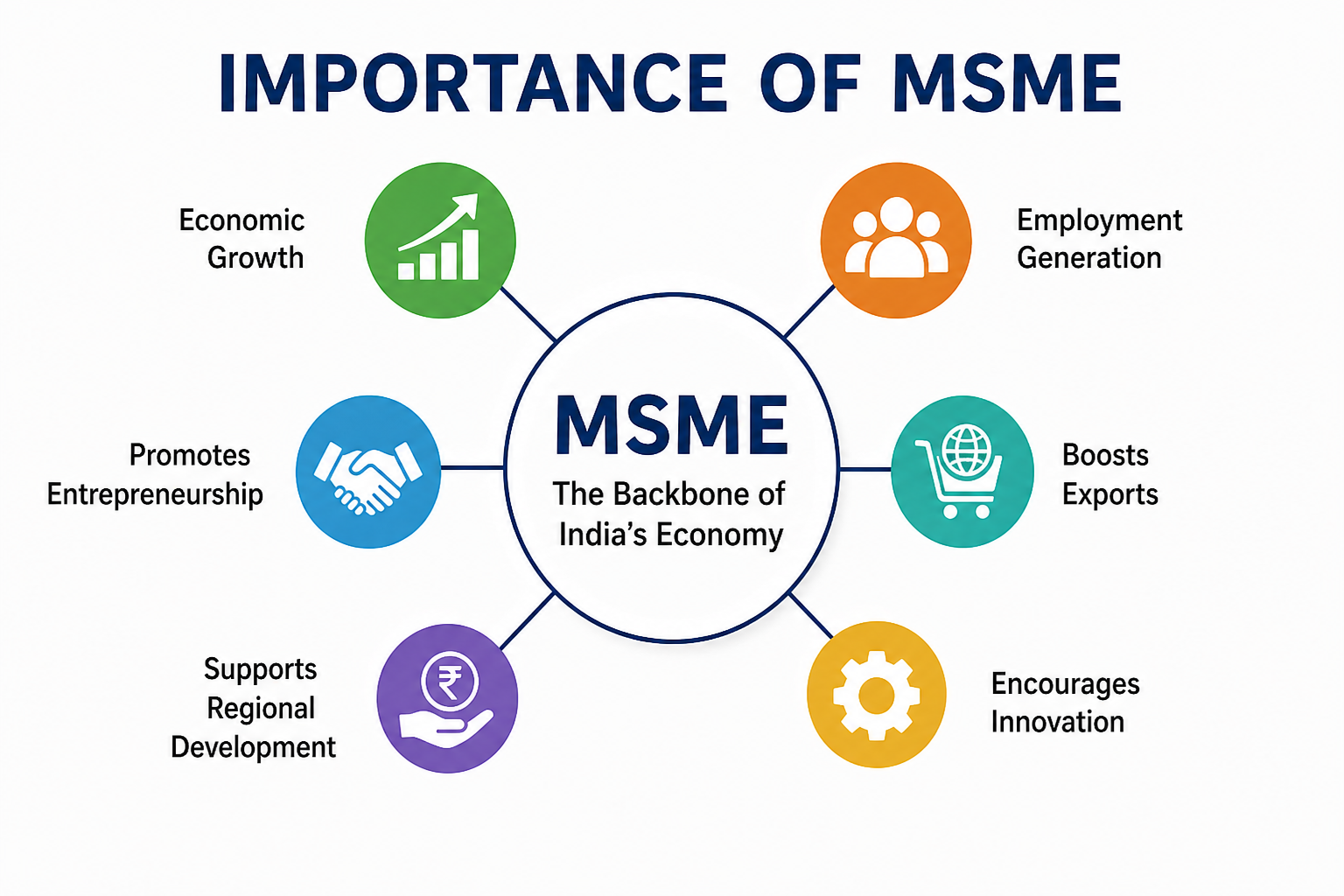
MSMEs play an important role in improving the Indian economy and promoting inclusive development.
- Contribution to GDP :- MSMEs account for around 30% of India’s GDP, making them a key engine of economic growth.
- Employment Generation :- MSMEs provide employment for about 110 million people in India, primarily in rural and semi-urban regions.
- Promoting Entrepreneurship :- MSMEs empower individuals to create their own enterprises with a small investment. They encourage innovation, entrepreneurship, and self-employment options.
- Boost Exports :- MSMEs contribute considerably to India’s exports by manufacturing items for overseas markets, hence increasing global competitiveness.
- Regional development :- MSMEs assist to revitalize rural and underserved areas by establishing local enterprises and limiting migration to cities.
Role of MSME in Project Finance
- Project funding is important to the growth and expansion of MSME businesses.
- Access to capital is one of the most significant difficulties facing MSMEs. Project financing enables firms to access capital for new or expanded activities.
- Business expansion with the right capital, MSMEs may increase production capacity, invest in machinery, and enter new markets.
- Financial planning project reports assist MSMEs in forecasting their income, costs, and profitability, resulting in improved financial management.
- Loan approval banks demand extensive project documentation before approving loans. A well-prepared report improves the chances of receiving funds.
Benefits of MSME Registration
Easy Loan Access :- MSME registration facilitates the simpler granting of loans at reduced interest rates for enterprises. For registered MSMEs, several banks and NBFCs provide loans without collateral.
Government Initiatives and Subsidies :- Benefits from a number of government programs, including financial assistance for company expansion, incentives, and subsidies, are available to registered MSMEs.
Benefits of Taxes :- MSMEs may save money and increase their profitability by taking advantage of a number of tax exemptions and a less regulatory load.
Tax Advantages :- MSMEs may increase their profitability and save money by taking advantage of a number of tax exemptions and a less compliance load.
Defense Against Payment Delays :- Buyers are required by MSME legislation to pay within a certain time frame. For small firms, this guarantees improved cash flow and lessens financial strain.
Challenges Faced by MSMEs
- MSMEs sometimes have limited access to financing owing to a lack of collateral and adequate documentation.
- They face severe competition from huge corporations and internet enterprises.
- Complex regulatory and GST compliance requirements cause operational issues.
- The lack of advanced tools decreases efficiency and production.
- Finding and maintaining an excellent staff is a significant problem for development.
- Client payments are delayed, which affects cash flow and working capital.
- Rising raw material and operational costs have an influence on overall profitability.
Government Support for MSMEs
The Indian government has implemented many plans to help MSMEs:
1. Mudra Loan Scheme.
2. PMEGP (Prime Minister Employment Generation Programme).
3. CGTMSE (Credit Guarantee Scheme).
4. Start-up India Scheme.
These programs promote MSMEs’ growth by offering financial aid and policy support.
Importance of Project Report for MSME Loan
- A project report is vital for MSMEs receiving bank loans since it clearly explains the company idea, cost, and financial predictions.
- It enables banks to assess the viability and profitability of a firm before approving funds.
- A well-prepared report raises the probability of a rapid loan approval and fosters confidence among lenders.
- It covers information such as market analysis, investment requirements, and predicted returns.
- Project reports are also useful for good financial planning and corporate strategy.
- They provide transparency and decrease risk for both the borrower and the bank.
- Overall, a solid project report serves as a road map for business expansion and successful loan acceptance.
How Sharda Associates Helps MSMEs
Sharda Associates provides complete support for MSME businesses, including:
1. MSME registration
2. Project report preparation
3. Bank loan consultation
4. Financial planning
5. GST and compliance services
With expert guidance, businesses can easily access funding and grow efficiently.
Frequently Asked Questions (FAQs)
- What are the existing criteria for identifying a firm as a Medium enterprise?
According to the 2020 government recommendations, a Medium firm is one that invests up to ₹50 crore in machinery and has a yearly revenue of ₹250 crore or less.
- Can a retail dealer or small shopkeeper register as an MSME in India?
Yes, the government recently broadened the MSME definition to include retail and wholesale businesses, allowing them to access priority sector loans and particular credit schemes via Udyam registration.
- Why should an MSME keep a complete project report, even if they have personal funds?
A project report serves as a strategic road map for growth, allowing you to track financial milestones, identify potential hazards, and retain transparency for prospective investors or bank loan needs.
- How can MSME certification safeguard a business owner from the issue of delayed payments?
Registered MSMEs can use the MSME Samadhaan portal. Buyers must pay within 45 days or risk incurring compound interest at three times the bank rate.
- What distinguishes the manufacturing and service sectors under the new MSME definition?
Under the 2020 revision, there is no distinction between the manufacturing and service sectors. Both now follow the same composite criterion based on investment and yearly turnover levels.
- Is it necessary to have a project report to obtain a Mudra bank loan?
While smaller “Shishu” loans need less documentation, “Kishor” and “Tarun” loans often demand a project report to verify the company’s potential to create income and return the borrowed funds.
- Can an established firm become an MSME if its turnover drops significantly?
Yes, if a company’s investment and turnover are within the defined limitations within a fiscal year, it can register or amend its status on the Udyam site to get MSME advantages.
- What papers are normally necessary to complete the MSME (Udyam) registration process?
The key needs are the proprietor’s or director’s Aadhaar card and the company’s PAN card. The site extracts turnover and investment information directly from the GST and Income Tax databases.