
What is agricultural income
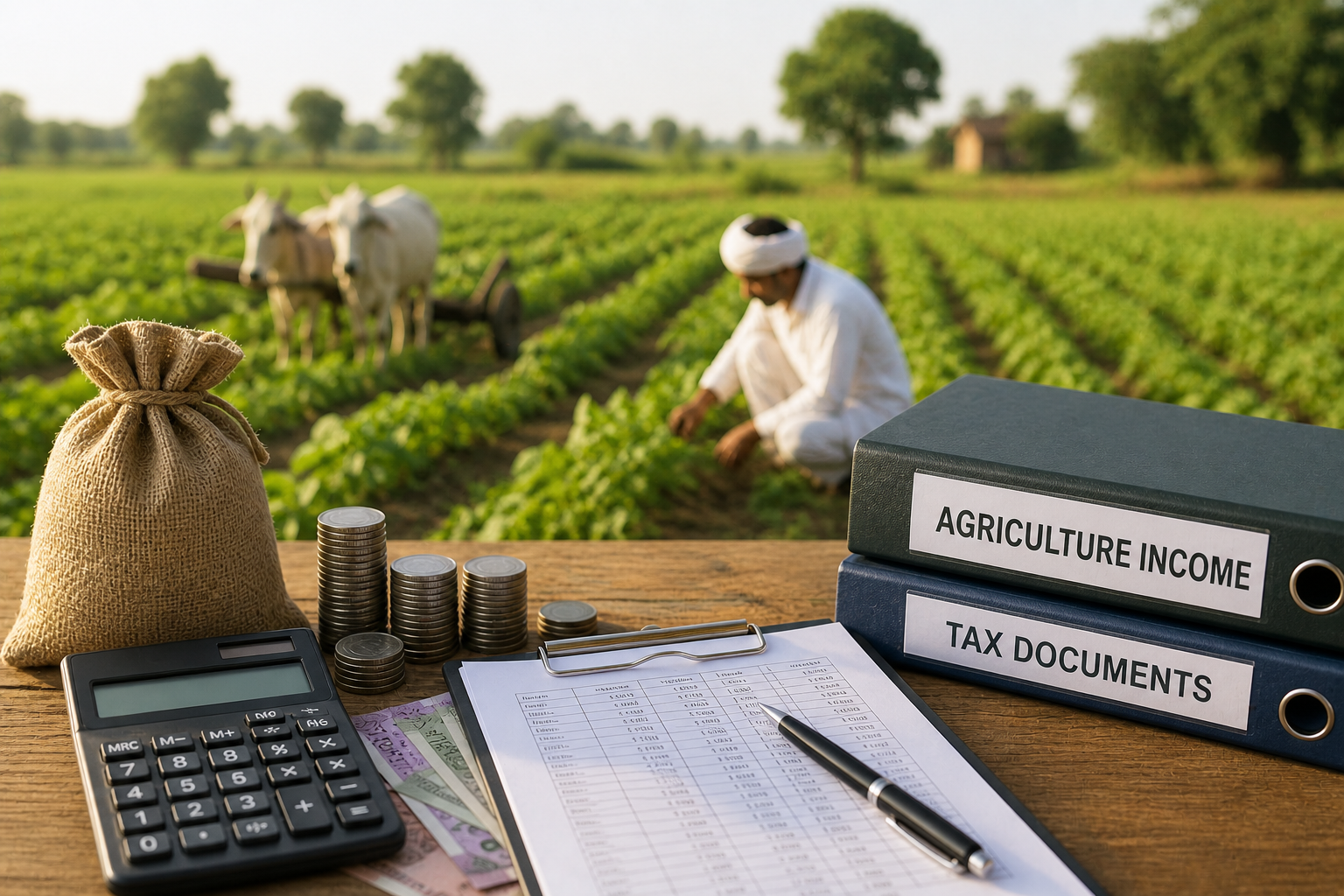
In India, agricultural income is defined as income derived from farming operations such as crop cultivation, agricultural land rental, and farm produce selling. Agricultural income is completely free from income tax in India under Section 10(1) of the Income Tax Act, although it may have an impact on tax calculations for other income due to partial integration restrictions.
Introduction to Agricultural Income Tax in India.
Agricultural income is vital to India’s economy because a big portion of the population relies on farming activities. Section 10(1) of the Income Tax Act of 1961 provides for a particular exemption for agricultural income.
This means that money from agricultural activity is rarely taxed directly by the Central Government. In some circumstances, it is still taken into account for computing tax on non-agricultural income.
In 2026, agricultural income standards are mostly same, but compliance methods and reporting via ITR and AIS have grown more digital and transparent.
Meaning of Agricultural Income in India.
- Agricultural revenue comprises all income derived from agricultural land in India. It mostly covers three forms of income.
- The first source of income is rent or earnings from agricultural land. Second, income generated by actual agricultural operations such as cultivation, harvesting, and farming. Third, income generated by farm structures used for agricultural purposes.
- It also includes income from nurseries, which grow saplings and plants for commercial sale.
- Simply put, any revenue that is directly related to farming activities is considered agricultural income.
What is included in the agricultural income
- Agricultural income comes from a variety of farming-related activities.
- It includes income from crop production, such as wheat, rice, fruits, vegetables, and other agricultural products. It also includes income from the sale of livestock products if they are directly related to farming operations.
- Renting out agricultural land generates agricultural income. If a farmer prepares products in a basic manner to make them marketable, this income can also be considered as agricultural income.
- In India, agricultural income includes money from nurseries and plant cultivation.
Taxation of Agricultural Income in India
Section 10(1) of the Income Tax Act exempts all agricultural income from taxation.
This means that individuals are not required to pay direct income taxes on agricultural earnings. However, there is one critical requirement that applies in some circumstances.
If a person has both agricultural and non-agricultural income, the agricultural income can be utilized to calculate the tax rate on non-agricultural income using a method known as partial integration.
This method assures that high-income persons cannot use the agricultural income exemption to minimize their overall tax liability.
Why is Agricultural Income Tax-Free in India?
Agricultural income is tax-free in India for a variety of economic and historical reasons.
Farming is heavily reliant on weather conditions, natural causes, and market swings. Income is unpredictable and dangerous, making taxation problematic.
Agriculture is also viewed as critical to the country’s food security. To help farmers and boost agricultural production, the government exempts this income from direct taxation.
Another issue is the difficulty of effectively measuring agricultural income, particularly in rural areas.
Partial Taxation on Agricultural Income
- Although agricultural revenue is exempt, it can nonetheless influence tax calculations via a mechanism called as partial integration.
- This is applicable when both agricultural and non-agricultural income exist. In such circumstances, agricultural revenue is included to taxable income solely to calculate the tax slab rate.
- After determining the total income tax, the agricultural income advantage is modified to guarantee fair taxation.
- This strategy ensures that people with a large income from non-agricultural sources do not receive undue tax breaks.
Agricultural Income Sources
In India, agricultural income is generated through a variety of farming-related activities.
It includes income from crops including wheat, rice, sugarcane, and vegetables. It also includes revenue from horticulture activities like fruits and flowers.
Income from dairy farming, poultry, and fisheries is generally not considered agricultural income unless it is closely related to land-based farming operations.
Agricultural income includes money from agricultural land rentals and farm building usage.
Income that is not agricultural.
Not all rural or farming-related income is classified as agricultural revenue.
Income from poultry farming, fisheries, and animal breeding is not typically considered agricultural income. Similarly, income earned in processing sectors where raw agricultural goods are significantly transformed is taxable.
Revenue earned from urban land used for commercial purposes is not considered agricultural revenue.
Any income not directly related to agricultural land or farming operations is considered taxable business income.
Tax Guidelines for Agricultural and Salary Income
If a taxpayer earns both farm income and salary or company income, the tax is calculated differently.
To calculating the tax slab, agricultural income is added to total income. Then tax is levied exclusively on non-agricultural income. Following that, changes are made to keep agricultural revenue exempt.
This technique ensures that agricultural income does not immediately raise tax liabilities while still influencing tax rates.
Agricultural Income and Capital Gains Tax
- The sale of agricultural land may also have tax repercussions.
- Agricultural land in rural areas is not considered a capital asset, hence capital gains tax does not apply.
- However, if agricultural land is located in an urban region, it is considered a capital asset and is subject to capital gains taxes.
- This distinction is significant for landowners and farmers who intend to sell agricultural property.
Latest Updates on Agricultural Income
Agricultural income provisions under the Income Tax Act will remain unchanged in 2026.
However, computerized reporting methods, such as AIS and Form 26AS, have increased openness in revenue tracking.
Tax authorities use artificial intelligence-based tools to track high-value agricultural revenue transactions.
Although the tax exemption remains, compliance reporting has been more stringent in order to prevent the exploitation of agricultural income claims.
Importance of Agricultural Income Exemption
Agricultural income exemption is essential for India since it benefits farmers and the rural economy.
It provides financial security for farmers whose income is variable due to natural circumstances.
It also helps to keep the country’s food supply chain stable.
The exemption boosts agricultural productivity and helps rural development.
Why Use Professional Project Report Services?
Expertise in financial planning, market research, and documentation is required while preparing a project report for a bank loan. A professionally designed bankable project report ensures accuracy and conformance to banking norms.
Sharda Associates offers:
- CA-certified project reports.
- Accurate financial projections
- Fast delivery.
- High loan approval success rate.
Choosing experienced services increases approval possibilities and ensures business success.
Frequently Asked Question
Q1. Is agricultural income taxable in India under Income Tax Act 2026 rules?
Agricultural income in India is exempt under Section 10(1) of Income Tax Act. However, it may affect tax rate calculation when combined with other non-agricultural income.
Q2. What types of income are considered agricultural income in India?
Income from cultivation of crops, rent from agricultural land, nursery operations, and farm building usage is considered agricultural income under Indian tax law.
Q3. Do farmers need to file income tax return on agricultural income?
Farmers do not pay tax on agricultural income, but they may need to report it in ITR if it exceeds specified limits or is combined with other income sources.
Q4. Is income from dairy farming considered agricultural income in India?
No, income from dairy farming, poultry, and fisheries is generally not treated as agricultural income unless directly linked with land-based farming activities.
Q5. What is partial integration in agricultural income taxation?
Partial integration is a method where agricultural income is added to non-agricultural income only for tax rate calculation, not for direct taxation.
Q6. Is agricultural land sale taxable in India?
Rural agricultural land is not taxable under capital gains tax. However, urban agricultural land is treated as capital asset and is taxable.
Q7. Why is agricultural income exempt from tax in India?
Agricultural income is exempt because farming income is uncertain, dependent on natural conditions, and essential for food security and rural economy.
Q8. Can agricultural income be misused for tax saving in India?
Tax authorities monitor high-value agricultural income through digital systems like AIS and Form 26AS to prevent misuse and ensure compliance.