
Project Report for Newspaper Printing
Starting a newspaper is one of the oldest ways to build a media business in India — and one that still works, just not the way the big dailies do it. Hyperlocal district papers, vernacular weeklies, and niche publications operate on very different economics from Dainik Bhaskar or Times of India. The project report needs to reflect which version you’re actually building. Starting ₹2,999.
Get your Report
Let's Be Honest About What This Business Is
In the context of a bank loan or PMEGP project report, “newspaper printing” usually refers to one of three things:
You want to start a newspaper—a district-level Hindi daily, a weekly English publication for your city, or a trade-specific newsletter-style paper. You require both the printing infrastructure (or printing vendor relationship) and the publication infrastructure (editing, distribution, and advertising). This is largely a media company with a print component.
Contract newspaper printing (printing for others): You are a commercial printing press looking to expand your services by producing runs for existing small newspapers, tabloids, or periodicals that outsource their printing to commercial presses. This is largely a printing firm that uses newspaper-specific equipment.
Combined (own publication + contract printing for others): This is a common strategy among smaller operators: you establish your own hyperlocal paper while simultaneously accepting contract printing work from other publishers to make better use of your press capacity.
The Honest State of Indian Newspaper Publishing
Before opting to create a newspaper, it is important to comprehend the landscape clearly:
The huge daily are struggling: but not extinct. National English newspapers and big Hindi newspapers such as Dainik Bhaskar and Amar Ujala are under threat from digital news consumption, but they remain powerful and profitable due to advertising volume and strong brand recognition that has taken decades to develop.
The regional and district opportunities are real: What the big papers can’t do well is cover the gram panchayat election results, a new road built in a specific taluka, and the local school’s annual sports results. Large newspapers have never excelled at providing hyperlocal coverage that is truly valuable to a specific community of 50,000-200,000 people, creating a sustained niche for district-level and hyperlocal periodicals.
Vernacular language publications: are more durable than English. Hindi, Marathi, Bengali, Telugu, and Tamil newspapers continue to thrive, particularly among the 35+ population and in smaller towns – readers who grew up with physical paper in their language have not transitioned to digital at the same rate as urban English-language readers.
A newspaper’s income model is based on two sources: circulation revenue (subscriptions and per-copy sales), and advertising revenue. Hyperlocal advertising targets local companies (shops, schools, hospitals, and real estate) rather than national brands. Local advertising is relationship-driven and takes active sales effort, but it is accessible and fairly priced provided you have a genuine readership in that area.
Two Very Different Equipment Requirements
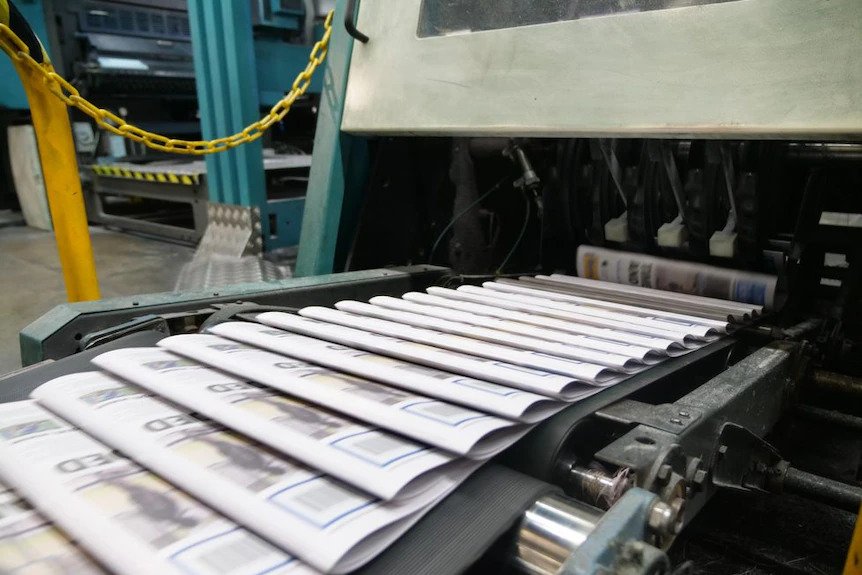
A web offset press feeds paper from a roll (web) rather than individual sheets, prints at high speeds (thousands of papers per hour), and is required for daily newspapers with a meaningful circulation (10,000+ copies). Web offset presses are costly (₹50 lakh-5 crore+ depending on configuration and speed) and need ample space, trained operators, and regular maintenance. This is not a basic press.
For weekly publications, newsletters, or very small circulation papers (below 5,000 copies), a sheet-fed offset press or a high-speed digital press (like a digital inkjet tabloid press) is more suitable and less capital-intensive (₹8-30 lakh range). The quality is generally adequate for a hyperlocal weekly, and the reduced fixed cost makes it financially sustainable with a smaller circulation.
Outsourced printing (no press): Many hyperlocal newspapers do not own a press; instead, they manage editorial, layout, advertising sales, and distribution while outsourcing the actual printing to a commercial press that serves multiple publications. This significantly decreases financial requirements (mostly editorial computers, design software, and working capital for initial printing runs) and is how many successful small periodicals began before investing on their own equipment.
Revenue Model for a Hyperlocal Newspaper
Advertising revenue (main): Most small newspapers’ primary revenue source is local business advertising, which includes classified listings, display ads, and institutional notices (government tenders, educational institutions, hospital announcements).
Government advertisement empanelment: The federal and state governments have empanelment procedures for newspaper advertising, known as the DAVP (Directorate of Advertising and Visual Publicity) at the central level and state government counterparts.
Calculate circulation revenue by multiplying: cover price by number of copies sold. Circulation revenue is secondary to advertising, with a typical local daily costing ₹3-5 per copy and a district paper with a paid circulation of 5,000-15,000.
RNI Registration Requirements: Any newspaper published in India must be registered with the Registrar of Newspapers for India (RNI), which is a legal requirement with a specified registration process and schedule.
Project Cost — Three Scenarios
Scenario | Project Cost (₹) |
No-press start (outsourced printing) | ₹2-5 lakh (editorial equipment, design software, initial printing + working capital) |
Sheet-fed/digital press (weekly, small circulation) | ₹12-35 lakh |
Small web offset press (daily, 5,000-15,000 copies) | ₹55 lakh-1.50 crore |
For PMEGP and Mudra: no-press start and sheet-fed/digital press both fit within PMEGP’s ₹50 lakh ceiling. Web offset press typically requires MSME term loan.
Why Choose Sharda Associates
- More than 45,500 project reports were delivered — Strong background in newspaper publishing, print media, magazine business, and media startup funding.
- Identifying the right publishing model first — We tailor the report to your specific company model, whether it’s outsourced printing, digital publishing, a weekly newspaper, or a full-scale printing plant.
- Advertising and circulation revenue are separately modeled — Revenue predictions include both circulation and advertising revenue, based on reasonable market assumptions.
- RNI Registration Requirements Documented — The report accurately reflects the Registrar of Newspapers for India (RNI) compliance, registration process, and timeline.
- Government Advertisement Growth Opportunity Noted — Future revenue potential include DAVP/Bureau of Outreach and Communication, as well as state government empanelment channels.
- Printing Technology Matched to Scale — Outsourced printing, digital printing, sheet-fed, and web offset technology suggestions are based on your circulation and investment capacity.
- Bank-Ready Financial Projections — Includes project costs, working capital, circulation projections, advertising revenue, profitability, DSCR, and loan repayment analysis.
- Starting at ₹2,999 · 24–48 working hours ·
📞 +91 89899 77769 | All India service
Frequently Asked Questions
A Newspaper Printing Project Report is a detailed business and financial document prepared for entrepreneurs planning to start or expand a newspaper printing unit. It generally includes the business model, printing capacity, machinery, raw materials, manpower, project cost, working capital, expected revenue, expenses, profitability and funding requirements.
For bank loan purposes, it may also include projected financial statements, cash flow, break-even analysis, DSCR and repayment schedules.
Banks and financial institutions may require a project report while assessing finance for a new newspaper printing unit or expansion project. It helps the lender understand the investment requirement, machinery, promoter contribution, working capital, expected revenue and repayment capacity.
Sharda Associates can prepare a customized bank-oriented Newspaper Printing Project Report based on the proposed business and loan requirement.
The investment depends on the proposed printing capacity, type of machinery, level of automation, premises, infrastructure and whether new or used equipment is purchased.
A customized project report should calculate the investment using actual machinery quotations, setup costs and working-capital requirements rather than using a standard figure.
A newspaper printing unit may require a web offset printing press, reel stand, plate-making or CTP system, folding unit, compressor, pre-press computers, cutting equipment and material-handling equipment.
The machinery requirement varies according to printing speed, page count, colour requirements and production capacity.
Web offset printing is a high-speed printing process where a continuous roll of paper passes through the printing press. The printed paper is subsequently cut and folded into newspaper sections.
It is commonly used for newspaper production because it is suitable for large-volume and high-speed printing.
Major expenses may include:
- Newsprint paper
- Printing ink
- Printing plates
- Electricity
- Employee salaries
- Machinery maintenance
- Rent
- Transportation
- Consumables
- Administrative expenses
- Interest on loans
The project report should estimate these expenses according to the proposed production capacity.
Revenue can depend on the chosen business model. A newspaper publisher may earn through newspaper sales, subscriptions and advertisements, while a contract printing unit may earn by printing newspapers or publications for third parties.
A project report should clearly identify each proposed revenue stream and calculate projected sales accordingly.
A detailed project report may include:
- Project cost
- Means of finance
- Working capital
- Projected sales
- Profit & Loss Statement
- Projected Balance Sheet
- Cash Flow Statement
- Depreciation
- Interest calculations
- Break-even analysis
- DSCR
- Loan repayment schedule
Sharda Associates can prepare these projections according to the actual machinery, capacity and financing structure of the proposed project.
A project report can be prepared for presenting a newspaper printing or printing-related business proposal to banks and financial institutions under applicable business-finance or government-linked schemes.
Eligibility for MUDRA, PMEGP or any other scheme depends on the applicant, project activity, investment and current scheme guidelines. The report can be customized according to the proposed project cost, promoter contribution and loan requirement.
Sharda Associates can prepare a customized Newspaper Printing Project Report for bank loan and financial evaluation.
The report can include project cost, machinery, printing capacity, newsprint consumption, working capital, means of finance, revenue assumptions, operating expenses, projected profitability, cash flow, projected balance sheet, break-even analysis, DSCR and loan repayment calculations.
It can be customized for a newspaper publishing unit, hyperlocal newspaper, contract printing press or web offset newspaper printing unit.