
Project Report for Wire Brush Manufacturing
The global wire brush industry is expected to expand from USD 621 million to more than USD 1 billion by 2033, and India’s 48,000+ metal fabrication units are a major contributor—every weld, corroded surface, and paint job need one. Sharda Associates, which has delivered over 45,500 CA-certified project reports, creates wire brush manufacturing project reports in 24-48 hours. Starting at Rs. 2,999.
Get Your Report
What Does a Wire Brush Manufacturing Business Actually Involve?
A wire brush appears to be a simple product — bristles set into a handle or wheel — but the manufacturing reality requires real precision in how those bristles are anchored, because a brush that sheds its bristles while in use is more than just a quality issue; it is a genuine safety concern for anyone using it on a power tool. This is a product used in nearly every metalworking, construction, and automotive maintenance operation in the country, making it a truly broad-demand business.
At the MSME scale, this business often produces across three related product categories, because the same core wire-setting equipment may substantially serve all three with attachment or dimension changes:
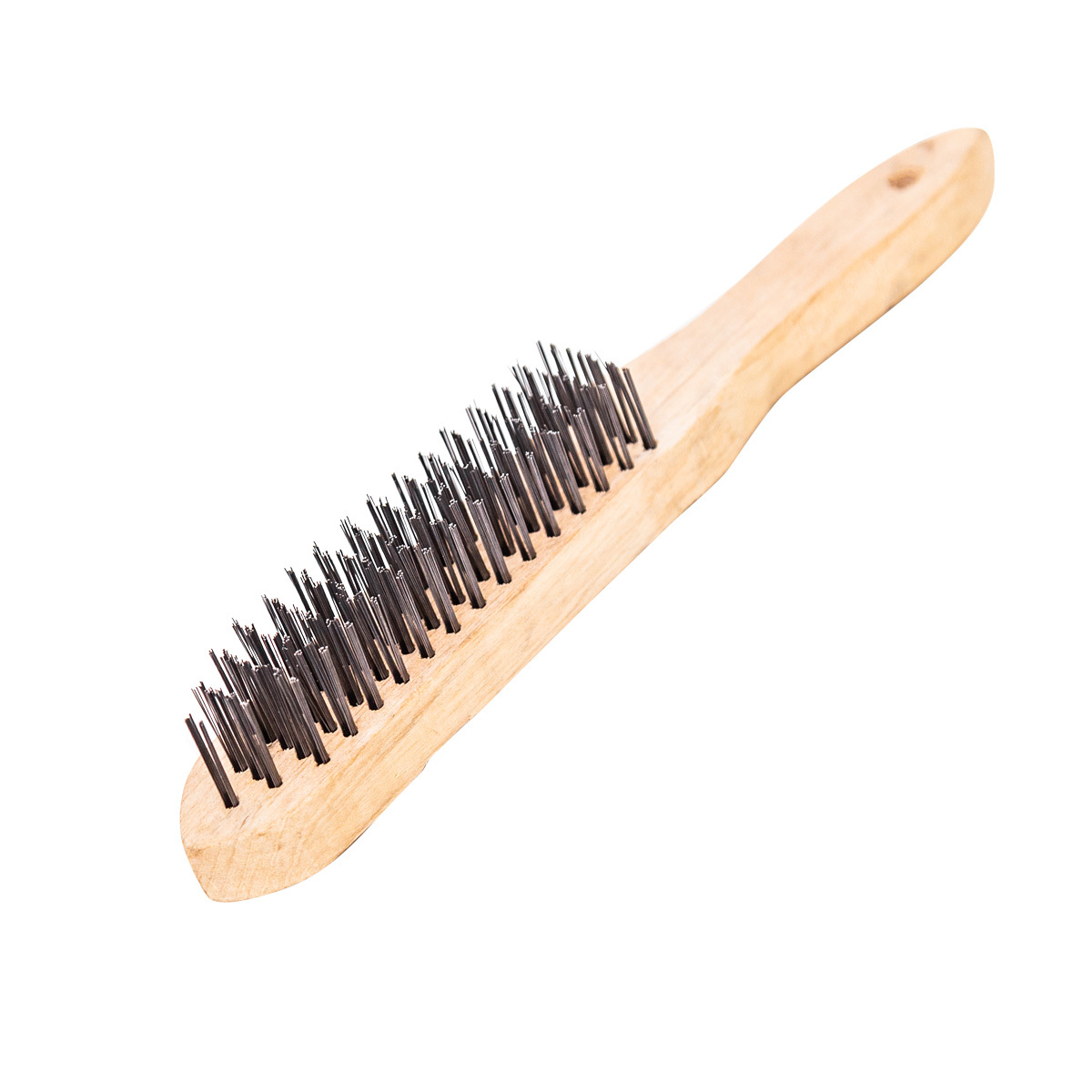
Handwire brushes. Wood or plastic-handled brushes for manual cleaning, rust removal, and paint stripping are the most popular and easily available entrance point, sold in hardware stores and to individual craftsmen.
Wheel and cup brushes are power tool attachments. Circular brushes mounted on a mandrel for use with angle grinders, bench grinders, and drills account for a significant portion of value in the industrial segment, as wheel brushes alone account for approximately 31% of total wire brush consumption globally, owing to power tool integration.
Why Bristle Retention Is the One Quality Issue That Actually Ends Buyer Relationships
Here’s the detail that counts more in our market than virtually any other spec: a wire brush, particularly a wheel brush spinning on a power tool at high RPM and shedding bristles during usage, poses a true harm danger – loose wire fragments flying off at high speeds.
This isn’t a small quality issue that necessitates a re-order; it’s the type of fault that raises liability concerns and terminates a B2B partnership instantly, because no fabrication shop or industrial buyer wants to expose their employees to that danger repeatedly.
A project report for this company should approach the wire-anchoring process — whether stapled, crimped, or twisted-in — as a legitimate, non-negotiable quality-control step, not a minor assembly detail to cut costs on.
How Does This Business Actually Make Money?
Pricing varies according to brush type and substance. A simple hand wire brush (steel wire, wood handle) sells wholesale for around Rs.12-30 per piece, depending on size and wire grade. Wheel and cup brushes for power tools, which require more precise mandrel attachment, cost between Rs.35 and Rs.150 per piece, depending on diameter and wire type (carbon steel, stainless steel, or brass). Industrial strip brushes and larger-format items, which are generally sold directly to manufacturing plants, cost Rs.200-1,500+ per unit depending on length and specification, and are frequently ordered as bespoke or semi-custom.
Revenue calculation (small unit, hand and wheel brush focus): 5,000 pieces/day combined across hand and wheel brushes × Rs.28 average wholesale × 24 working days = Rs.33.6 lakh/month gross revenue.
Material selection has a significant impact on both cost and addressable market — stainless steel wire commands a premium and serves food processing, pharmaceutical, and marine applications where corrosion resistance and contamination control are important (a smaller but genuinely valuable niche), while standard carbon steel serves the larger general industrial and construction market, and brass serves lighter-duty applications where scratching softer materials is an issue. According to industry data, stainless steel and carbon steel account for around 70% of global wire brush manufacturing, therefore a realistic product mix should focus on these two materials rather than treating all three as equal-volume sectors.
What Equipment Does a Wire Brush Manufacturing Unit Need?
- Wire straightening and cutting machine. For preparing wire to regular lengths from coil stock, a basic setup costs between Rs.1.5 and 3.5 lakh.
- Wire setup and twisting machine (for twisted-in-tuft brushes). This is the core specialised machine for this business — it twists wire tufts and sets them into the brush core or handle with mechanical anchoring that determines bristle retention quality — it costs between Rs.3 and 8 lakh depending on automation level, and it is the single equipment investment that should not be overlooked due to its direct impact on quality.
- Staple/crimping machine (for stapled-tuft brushes). An alternate or complimentary anchoring procedure for some brush styles costs Rs.1-2.5 lakh.
- Handle and core moulding or turning equipment. Producing wood handles (turning) or plastic/composite handles (moulding) and wheel cores costs between Rs.2 and Rs.6 lakh, depending on whether you’re working with wood, plastic, or both.
- Assembly and finishing stations. Trimming bristle length to a uniform finish, attaching handles, and quality-checking each unit costs between Rs.1 and 2.5 lakh for a basic multi-station setup.
- Bristle retention testing equipment. Simple but important: a method to ensure that wire anchoring holds under stress before a batch ships, particularly for wheel brushes intended for high-RPM power tool use — Rs.50,000-1.5 lakh, and increasingly expected by industrial buyers who’ve had negative experiences with badly anchored brushes elsewhere.
What Actually Separates a Manufacturer Buyers Trust From One They Don't
Two wire brush producers utilizing identical-grade wire can produce significantly different products, and the difference is almost always due to the uniformity of the wire-anchoring procedure rather than the wire itself. A unit that manages tuft tension and anchoring depth reliably creates brushes with bristles that last their whole working life. A unit that is inconsistent on this step, even on occasion, produces some brushes that shed prematurely, and because the failure mode here has a genuine safety dimension rather than just a performance complaint, it spreads through trade word-of-mouth faster and more damagingly than a typical quality issue in most other product categories.
Wire grade consistency is important for another reason: a buyer ordering “carbon steel wire brushes” expects consistent hardness and springiness from batch to batch, as this directly influences how vigorously the brush cleans and how long it lasts with repeated use. A realistic project report views wire sourcing consistency and the anchoring process as genuine, continuing quality-control costs, not as a line item to be reduced.
A typical unit’s staff structure includes a production supervisor in charge of wire-setting quality (Rs.14,000-22,000/month), wire-setting and assembly operators (Rs.9,000-13,000/month each), and finishing/packaging assistance (Rs.7,000-9,000/month).
Where Should You Set This Up, and Who Buys This Product?
Proximity to wire and steel suppliers is important for cost and consistency. India has steel wire production and trading hubs in various states, and setting up near an established wire supply chain lowers both raw material costs and the risk of uneven wire quality from a less reliable source.
On the selling side, the realistic buyer base is truly broad — hardware and tool retailers (the largest volume channel for hand and standard wheel brushes), the automotive repair and bodywork sector (rust removal, surface prep before painting), construction and fabrication units (over 48,000 such units operate in India, and wire brushes are a routine consumable in their operations), and increasingly, food processing and pharmaceutical facilities for stainless steel Export demand is also worth considering, since Indian wire brush manufacturers have a strong presence in both domestic and foreign markets due to competitive raw material and labor costs.
Compliance requirements include BIS standards, when applicable for industrial tool categories, standard Udyam/MSME registration, and GST registration. Buyers frequently require verification on material food-safety compliance for stainless steel components when targeting the food processing or pharmaceutical sectors.
What Will This Actually Cost You?
Setup | Capital Cost (Rs.) |
Small unit (hand and standard wheel/cup brushes) | Rs.10-22 lakh |
Medium unit (wider product range including stainless steel and industrial sizes) | Rs.22-45 lakh |
Larger unit with automated wire-setting and industrial strip brush capability | Rs.50 lakh-1 crore |
Small and medium units typically fit Mudra Tarun or PMEGP under the manufacturing sector, with PMEGP’s 15-35% capital subsidy improving the project’s return profile for a first-time entrepreneur. A larger unit investing in automated production and industrial strip brush capability usually moves into MSME term loan territory, often structured with CGTMSE collateral-free coverage for the eligible portion.
Why Choose Sharda Associates ?
- We’ve generated over 45,500 CA-certified project reports, and wire brush manufacturing files include one detail that determines whether a bank takes the report seriously: if it recognizes bristle-retention quality control as a true, safety-relevant activity.
- We base your report on a realistic, broad product mix rather than a single brush type in isolation. Hand brushes, wheel/cup brushes, and industrial strip brushes all use the same underlying equipment but serve very distinct buyers and pricing points – we simulate your realistic combination rather than an oversimplified single-product approach.
- Wire-anchoring and quality-control costs are itemized honestly, showing that this phase is safety-critical, not a minor assembly detail – a report that minimizes this cost to appear more profitable on paper misrepresents the true quality investment this firm requires.
- The material mix is modelled to mirror actual demand trends. Stainless steel and carbon steel account for approximately 70% of global wire brush production; therefore, we weight your raw material plan properly rather than treating all wire kinds as equal-volume segments.
- The study includes your realistic buyer base — hardware retail, automobile repair, fabrication units, and, when applicable, food/pharma-grade stainless steel demand — to reflect how widely and differently this commodity is sold within India’s metalworking and maintenance industry.
- Before you even receive the report, your DSCR is validated to be greater than 1.25, based on your realistic production volume and mix. Starting at Rs.2,999, we deliver in 24-48 hours and offer free revisions until your bank or PMEGP application is approved. Call +91 89899 77769.
Frequently Asked Questions
It is a manufacturing company that makes brushes with metal bristles (steel, stainless steel, or brass) for cleaning, rust removal, paint stripping, deburring, and surface finishing applications. Revenue is generated through per-piece wholesale sales of three related product categories: hand brushes (Rs.12-30/piece), wheel and cup brushes for power tools (Rs.35-150/piece), and industrial strip brushes (Rs.200-1,500+/piece). A small unit concentrating on hand and wheel brushes can make approximately Rs.34 lakh in gross revenue per month at typical volume and price.
A small plant producing hand and standard wheel/cup brushes typically costs Rs. 10-22 lakh. A medium unit with a wider choice of options, including stainless steel and industrial sizes, costs between Rs. 22 and Rs. 45 lakh. A larger machine with automated wire-setting equipment and industrial strip brush capacity costs Rs. 50 lakh to 1 crore.
Yes. Small and medium wire brush manufacturing companies normally fall under PMEGP's manufacturing sector category, with loans of up to Rs.50 lakh and a capital subsidy of 15-35%. Larger units with automated manufacturing and industrial-segment capabilities sometimes exceed the PMEGP's limit and enter MSME term loan territory instead.
A wire brush, particularly a wheel brush used on a high-RPM power tool, that sheds bristles during usage poses a serious injury risk due to loose wire fragments flying off at high speeds. This makes bristle-anchoring quality a safety issue, not just a performance issue — and it's precisely why this defect terminates B2B buyer relationships rather than simply costing a re-order, because industrial and fabrication buyers will not risk repeated worker exposure to a brush with inconsistent wire retention.
The main materials are steel wire (carbon steel for general-purpose, heavy-duty cleaning), stainless steel wire (for corrosion-resistant applications such as food processing and pharmaceutical use), and brass wire (for lighter-duty applications where scratching softer materials is an issue). Stainless steel and carbon steel account for approximately 70% of global wire brush production. Hand brushes often have wooden or plastic handles, while wheel and cup brushes have a metal core.
Core equipment includes a wire straightening and cutting machine (Rs.1.5-3.5 lakh), a wire-setting/twisting machine — the most important single piece of equipment in terms of direct quality impact (Rs.3-8 lakh), a stapling/crimping machine for certain brush styles (Rs.1-2.5 lakh), handle/core moulding or turning equipment (Rs.2-6 lakh), and assembly/finishing stations.
Hand and standard wheel brushes are most commonly sold through hardware and tool dealers. They are widely used in the automotive repair and bodywork industry to remove rust and prepare surfaces for painting. Wire brushes are a common consumable in welding and metalworking activities in construction and fabrication companies in India, which number over 48,000. Food processing and pharmaceutical facilities represent a tiny but lucrative market, particularly for stainless steel brushes that meet hygiene criteria.
Hand brushes are manual cleaning equipment with wood or plastic handles that are mostly marketed to individual tradespeople through retail – the most popular and easily accessible product category. Wheel and cup brushes, which attach on a mandrel for use with angle grinders and drills, account for approximately 31% of total wire brush consumption globally due to power tool integration. Industrial strip brushes are larger-format devices designed for conveyor cleaning and automated systems that are marketed directly to industrial companies at a higher per-unit price but lower volume.
BIS standards are used where applicable for industrial tool categories. Standard Udyam/MSME registration and GST registration apply to any manufacturing firm. If you are targeting food processing or pharmaceutical buyers, anticipate to offer evidence about food-safety material compliance for stainless steel components, as these buyers often request it before making orders.