
Quick Answer
If you change the machinery supplier before disbursement, the bank will normally pause the release of funds and review the new supplier’s quotation, specifications and price against what it sanctioned. If the new machinery is equivalent and the bank approves in writing, disbursement usually continues, often with a recalculated loan and margin amount. If you order or pay the new supplier without informing the bank, the file can be delayed or questioned. Your sanction letter is the final reference.
Introduction
A supplier change often happens at the worst moment. The loan is sanctioned, the documents are almost complete, and then the original vendor delays delivery, revises the price, or a better offer comes along. The natural worry is whether this will put the whole loan at risk.
The good news is that a change of supplier does not automatically cancel a sanction. A machinery loan is appraised on the project cost, the machinery list, the technical specifications and your margin money. But because the bank pays against an invoice linked to the sanctioned proposal, it wants to know about the change before any money moves.
At Sharda Associates, we prepare CA-certified project reports, CMA data and DPRs, and handle bank documentation for MSME and government scheme loans. This guide explains what the bank checks, how your loan file is affected, what to do if an advance is already paid, and the steps that keep disbursement on track.
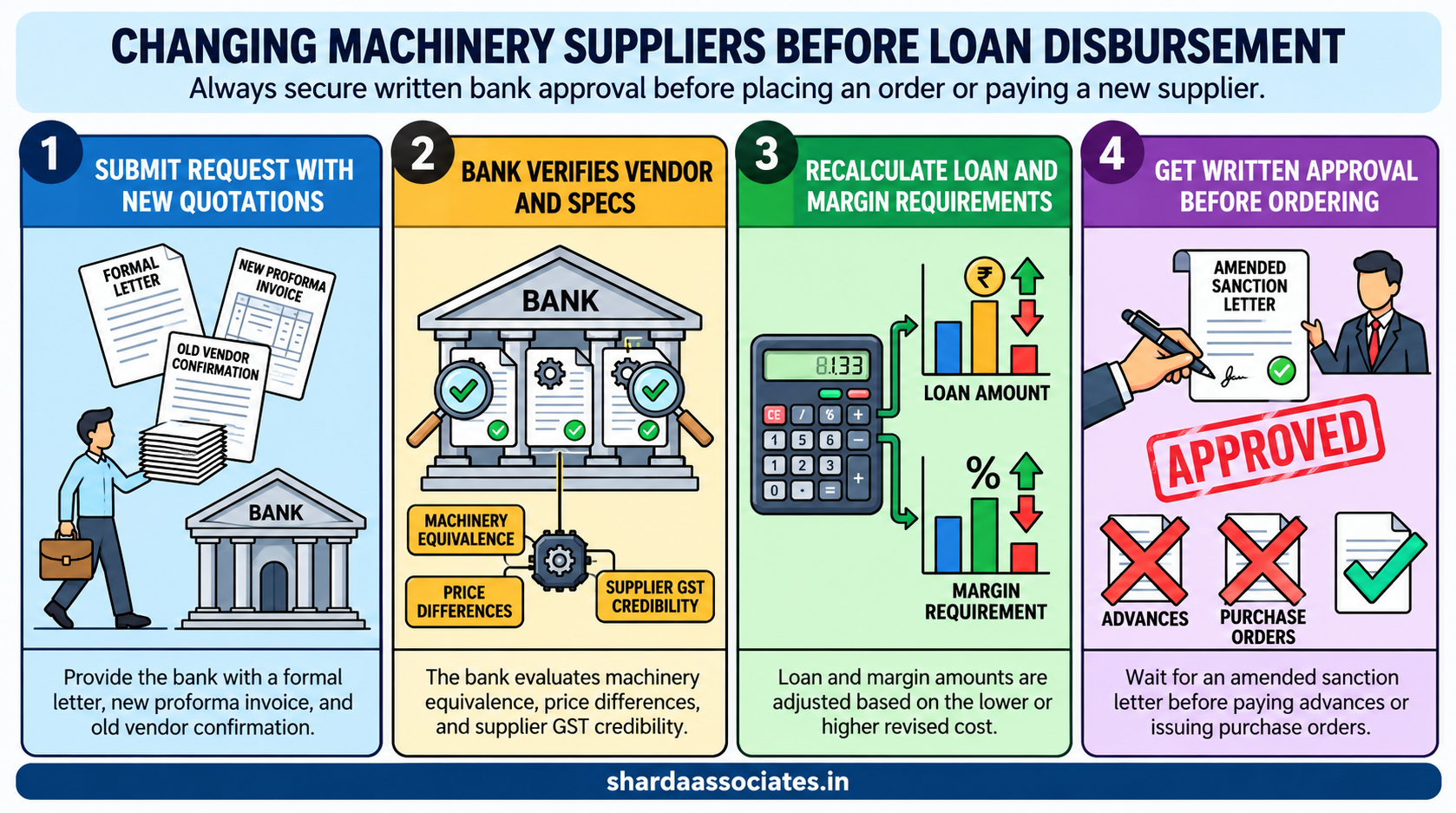
What the Bank Checks When the Supplier Changes
Most banks look at the same few points before agreeing to a new vendor:
- Equivalence of machinery. Does the new machine serve the same purpose, with similar make, capacity and specifications?
- Price. How does the new quotation compare with the one the bank appraised?
- Supplier credibility. GST registration, address, bank account details and track record.
- Project viability. Whether the revised cost still keeps the project and repayment capacity workable.
- Delivery and installation terms. Timelines, warranty and after-sales support.
Policies differ from bank to bank, so the conditions in your own sanction letter decide what is required.
How a Supplier Changes Affect Your Loan File
Once you inform the bank, expect these effects:
- Disbursement is usually put on hold until the bank reviews the new quotation.
- The appraisal may be updated, especially if the cost or specifications differ.
- The loan amount and margin money may be recalculated if the bank finances a percentage of actual cost.
- Fresh supplier documents are collected, such as the proforma invoice and supplier details.
- A written approval or amended sanction terms may be issued, depending on the size of the change.
A small, well-documented change is usually quicker to clear than a large or unexplained one.
Does the Sanction Remain Valid?
In most cases the sanction remains in place, provided the project stays substantially the same and the bank approves the change. A sanction can run into trouble if the change is large, the machinery is materially different, the information given earlier turns out to be incorrect, or the sanction validity period expires while the change is being reviewed. Check the validity date in your sanction letter, and if time is short, ask the bank in writing for an extension.
What Happens to Cost and Margin Money?
- New price is higher: the sanctioned amount does not automatically increase. You may need to fund the extra cost yourself, or request an enhancement, which means a fresh appraisal.
- New price is lower: the bank may finance a percentage of the lower actual cost, so the loan and your margin may both reduce.
- Price is the same: usually only the supplier details and invoice need to be updated.
Always ask the bank how the revised figures will be calculated, and get this in writing.
Documents the Bank Will Usually Ask For
- A written request explaining why you want to change the supplier
- New proforma invoice or quotation with machine specifications
- Withdrawal letter or confirmation from the original supplier
- Side-by-side comparison of the old and new quotations
- Supplier GST registration, PAN, address and bank details
- Revised project cost and means of finance, if the amounts change
- Updated margin money proof, if required
- Revised CMA data or project report pages, if the bank asks
If You Have Already Paid an Advance to the Original Supplier
Tell the bank immediately. The bank will want to know how much was paid, from which account, and whether the amount can be refunded or adjusted. Keep the payment proof, the supplier’s receipt, and any written communication about cancellation or refund. Do not assume the bank will recognise an advance it was never told about. Where the advance came from your margin money, the bank may also want to see how the margin requirement will be met again.
Supplier Changes on Subsidy-Linked Loans
For loans under government schemes such as PMEGP, the scheme agency’s guidelines also apply alongside the bank’s rules. A change of supplier may need additional intimation or approval, and the subsidy is generally linked to the eligible cost, so a change in price can affect it. Check the scheme guidelines and speak to the implementing agency before you proceed.
Scenario: A Textile Unit Supplier Changes Its Vendor
(Illustrative example, figures are not from any real case)
A small textile unit has a term loan sanctioned for stitching and finishing machinery. Before disbursement, the original vendor informs the owner that delivery will take much longer than promised. Another vendor offers equivalent machines at a slightly lower price with faster delivery.
Instead of paying the new vendor, the owner writes to the branch with the new proforma invoice, the machine specifications, a comparison with the old quotation, and the original vendor’s confirmation. The bank reviews the papers, confirms in writing that the new vendor is acceptable, and recalculates the loan and margin on the revised invoice. Disbursement then goes ahead against the new invoice.
The key difference was the order of steps: documents first, written approval next, payment last.
Mistakes That Put Disbursement at Risk
- Placing the order with the new supplier before the bank agrees
- Paying a large advance without informing the bank
- Choosing a supplier with no GST registration or unclear background
- Submitting an invoice that does not match the machinery the bank sanctioned
- Changing make, model or capacity without telling the bank
- Relying on verbal approval from the branch
- Ignoring the sanction validity date while the change is under review
- Skipping scheme-agency intimation on subsidy-linked loans
Step-by-Step Plan Before You Switch
- Read the sanction letter and note the conditions on supplier, cost and validity.
- Get at least two quotations and compare specifications, price, warranty and delivery.
- Verify the new supplier’s GST registration and background.
- Write to the branch manager with the reason and supporting documents.
- Wait for written approval or an amended sanction before ordering.
- Confirm how the loan and margin will be recalculated.
- Update your project report or CMA data if the figures change.
- Pay only after the bank confirms the process, and keep all records.
Conclusion
Changing the machinery supplier before disbursement is possible, and banks deal with such requests regularly. What matters is that the change is genuine, the machinery is equivalent to what was appraised, and the bank approves it in writing before you commit.
Expect a pause while the bank reviews the new quotation, and be prepared for the loan amount and margin money to be recalculated. If an advance has already been paid, tell the bank early and keep every receipt and communication on record.
A realistic, CA-certified project report with accurate CMA data makes such revisions easier to handle, because the bank can see how the changed cost fits into the project. If you need help with the revised figures or the request to the bank, our team can guide you.
Frequently Asked Questions
1. Can I change the machinery supplier after my loan is sanctioned?
Yes, you may be able to change the supplier, but you should inform the bank before disbursement and obtain approval if required under the sanction terms.
2. Will changing the machinery supplier delay loan disbursement?
It can. The bank may need to verify the new supplier, quotation, machinery specifications, cost, and other details before releasing the loan amount.
3. Do I need a new quotation from the replacement supplier?
Usually, yes. The bank may ask for a fresh quotation showing the machinery model, specifications, price, taxes, installation charges, and other relevant costs.
4. What if the new machinery costs more than the original quotation?
The additional cost may have to be funded by your own contribution unless the bank approves a revised project cost or loan amount.
5. What if the new machinery costs less than the sanctioned amount?
The bank may disburse only the eligible amount based on the actual purchase cost. The unused portion may not be released.
6. Can the machinery specifications be changed along with the supplier?
Possibly, but significant changes in machinery specifications may require the bank to reassess the project, loan eligibility, cost, and technical feasibility.
7. Will the bank pay the new supplier directly?
In many machinery-finance cases, the bank may disburse the eligible loan amount directly to the supplier against required invoices and documents. The exact process depends on the bank’s sanction terms.
8. What documents does the bank need when changing the supplier?
The bank may request the new supplier’s quotation, proforma invoice, GST details, machinery specifications, revised cost details, and other documents required under the sanction conditions.
9. Can I pay the new supplier before getting bank approval?
It is generally better to inform the bank and obtain the required approval before making a payment that is intended to be covered by the loan. Follow the disbursement conditions in your sanction letter.
10. Does changing the supplier affect my machinery loan approval?
Not necessarily. If the replacement machinery and supplier meet the bank’s requirements and the project remains financially viable, the change may be accepted. Final approval rests with the bank.