
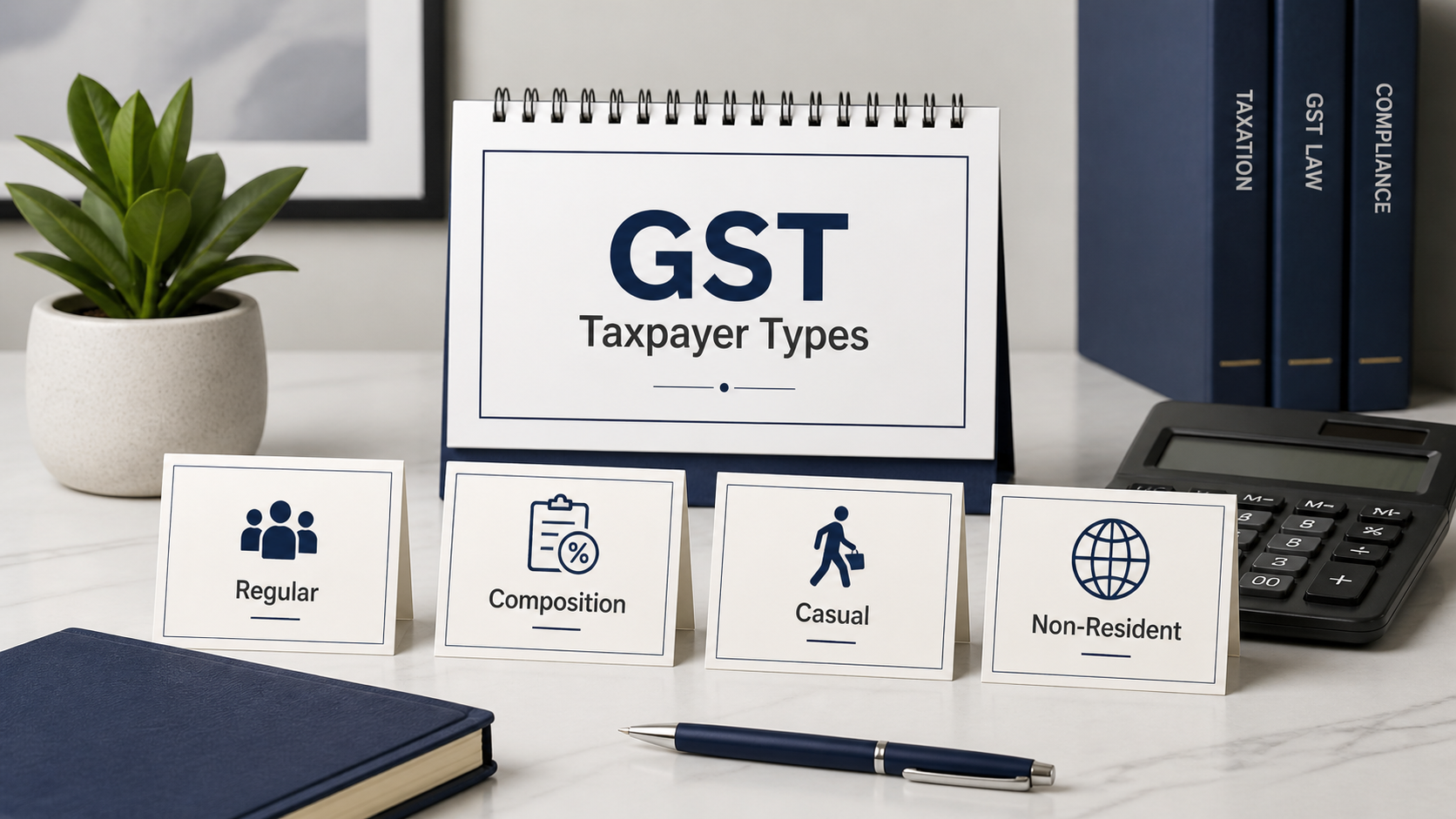
The types of taxpayers under GST in India 2026 have a significant impact on how enterprises and people comply with Goods and Services Tax legislation. Every taxpayer category has its own set of laws, perks, and compliance requirements based on turnover, kind of business, and operational structure.
Choosing the correct GST category is essential for:
- Proper tax compliance.
- Accurate return filing
- Obtaining Input Tax Credit (ITC)
- Ensure seamless business operations.
Understanding GST taxpayer categorization will help you make better financial and business decisions, whether you’re a startup, MSME, freelancer, or major corporation.
Understanding GST Taxpayer Classification in India
Meaning of GST Taxpayer Categorise
GST taxpayer classification categorizes organizations and people based on their turnover, nature of operations, and registration type. These groups include regular taxpayers, composition dealers, casual taxable people, and others, each with their own set of tax regulations and compliance obligations.
Why GST Classification is Important for Businesses
Identifying the correct GST category is critical for maintaining tax compliance and avoiding fines. It enables firms to obtain qualified advantages such as the Input Tax Credit (ITC), follow proper return filing processes, and increase overall financial and operational efficiencies.
Regular GST Registered Taxpayers
- This classification includes companies who choose not to use any particular strategy, such as composition.
- Standard GST regulations and compliance processes must be followed.
- Regular GST returns, such as GSTR-1 and GSTR-3B, must be filed.
- Qualified for Input Tax Credit (ITC) on purchases
- Free to engage in interstate commerce
- Able to use e-commerce platforms to offer products and services
- Ideal for expanding companies and MSMEs looking to grow
- increases the legitimacy and acceptance of businesses in B2B transactions.
Benefits of Regular GST Registration
- Advantage of Input Tax Credit :- The Input Tax Credit (ITC), which lowers overall tax obligations and increases profit margins, is available to regular taxpayers on purchases. This keeps companies’ prices competitive.
- Flexibility in Inter-State Trade :- Companies are not restricted in their ability to perform interstate sales. This broadens the market and fosters company expansion throughout India.
- Increased Trust in Businesses :- Particularly in B2B operations, regular GST registration boosts confidence between customers and suppliers. It improves a company’s dependability and professionalism in the marketplace.
- Possibility of E-Commerce Selling :- There are no limitations on registered firms’ ability to offer goods online. Higher income potential and digital growth are made possible by this.
Composition Scheme Taxpayers Under GST
- Small companies having a streamlined tax structure that are registered under the GST Composition Scheme
- Instead of using standard GST rates, pay GST at a predetermined rate based on turnover.
- Only eligible if turnover stays under the government’s set parameters
- Input Tax Credit (ITC) is not available for purchases.
- Prohibited from conducting business or selling goods over state lines
- Selling via e-commerce platforms is prohibited.
- Instead of a tax invoice, a bill of supply must be issued.
- Ideal for local service providers and small business owners
- Compared to the standard GST system, there are less criteria for compliance.
- Not the best option for companies looking to develop or expand
Input Service Distributor (ISD) Under GST
Interpretation of Input Service Distributor :- A GST-registered company that gives its branches or units Input Tax Credit (ITC) on input services is known as an Input Service Distributor (ISD). Organizations having various locations are the primary users of it.
ISD’s function in the GST system :- The appropriate distribution of tax credits among the various branches is guaranteed by the ISD mechanism. This prevents the loss of qualified input credits and promotes effective tax use.
Relevance of ISD Registration :- ISD does not apply to commodities, it only applies to input services. In order to issue tax credits, businesses must register separately for GST as an ISD.
Advantages for Companies :- Internal accounting accuracy and openness are enhanced by ISD. By effectively utilizing the input tax credit that is available, it also aids in lowering the overall tax burden.
E-Commerce Operators as GST Taxpayers
Online platforms that enable the selling of products or services, such marketplaces that link consumers and sellers, are known as e-commerce operators. These platforms are regarded as distinct taxpayers with particular compliance obligations under GST.
1. Requirements for GST Registration
Regardless of sales restrictions, e-commerce firms are required to register under GST. Additionally, sellers using these sites must register for GST.
2. Mechanism for Tax Collection at Source (TCS)
On behalf of sellers, e-commerce companies must collect Tax Collected at Source (TCS) and deposit it with the government. This guarantees accurate online transaction tracking.
3. Effects on Vendors and Sellers
When selling via e-commerce platforms, sellers are required to abide with GST regulations. Transparency is increased, but internet enterprises also have additional compliance needs.
GST Registration for Small Businesses and MSMEs
- GST registration is required if turnover above the specified threshold limitations.
- Businesses below the cap were able to profit from voluntary registration.
- Permits the Input Tax Credit (ITC) to be claimed on purchases
- Increases suppliers’ and consumers’ faith in the company
- Necessary for interstate commerce and e-commerce sales
- Facilitates MSMEs’ access to financial incentives and government programs
- Encourages more organized corporate processes and improved compliance.
- Increases the likelihood of project financing eligibility and loan approval
- Participating in B2B supply chains is essential.
- Encourages sustained company development and expansion
How Sharda Associates Help
Sharda Associates provides complete support in GST registration, tax compliance, and project report for bank loan approval. They help businesses choose the right GST category, avail MSME schemes, and manage financial planning efficiently, ensuring smooth operations and better growth opportunities.
Frequently Asked Questions
Q1: In 2026, what is the required GST registration level for a service provider?
In order to be in compliance with federal tax regulations, a service provider must register for GST if their total yearly sales exceeds ₹20 lakh (₹10 lakh in special category states).
Q2: Is it possible for a “Casual Taxable Person” to claim Input Tax Credit for short-term business expenses?
In order to offset the advance tax payment needed during their temporary registration term, a Casual Taxable Person is qualified for full ITC on inbound supplies.
Q3: How are businesses with several branches impacted by the new mandatory “ISD Mechanism”?
In order to provide common input service credits, businesses must register as an ISD starting in April 2026. The new regulations severely restrict the use of cross-charge invoices for common services.
Q4: Do small merchants who use e-commerce sites like Amazon or Flipkart have to register for GST?
Regardless of their overall yearly turnover or business size, anybody selling items through e-commerce operators must register from the first rupee of sales.
Q5: How long may a “Casual Taxable Person” register for in 2026?
The registration has a 90-day initial validity period that can be extended by an additional 90 days. A Regular GST registration is required for exhibits lasting more than 180 days.
Q6: Does India force non-resident taxable individuals (NRTP) to pay taxes in advance?
In order to lawfully start doing business in India, a NRTP must, in fact, submit an advance tax deposit equal to their expected tax obligation for the registration term.
Q7: In the midst of a fiscal year, is it possible for an ordinary taxpayer to transition to the Composition Scheme?
No, you may only use the Composition Scheme option at the start of a fiscal year by submitting Form CMP-02 by April 1st.
Q8: What does “GSTR-2B” mean to an ordinary taxpayer in 2026?
The final authority for claiming ITC is GSTR-2B, a static declaration generated by AI. You cannot get credit for an invoice if it doesn’t show up in 2B.