
In 2026, obtaining financial support for a new or existing business—whether through traditional banking channels or government-backed schemes like PMEGP, CMEGP, or Mudra—requires one crucial document: a Project Report. A well-structured and comprehensive Project Report for a Loan is the foundation of a successful loan application. It reflects the business potential, financial planning, and repayment capacity of the applicant.
Project Report for Bank Loan, including insights for PMEGP Project Report, CMEGP Project Report, Mudra Loan Project Report, and how to structure both a Detailed Project Report for Bank Loan and a Feasibility Project Report.
What is a project report?
A project report is a structured business document that outlines the objectives, operations, market analysis, funding requirements, and financial projections of a proposed business or an existing one seeking expansion. This report is necessary whether you are applying for a Bank Loan, PMEGP, CMEGP, or a Mudra Loan.
The Project Report for the Loan demonstrates the practicality of the business idea and includes both qualitative and quantitative data. It is also used as a base document to prepare a Feasibility Report or a feasibility project report.
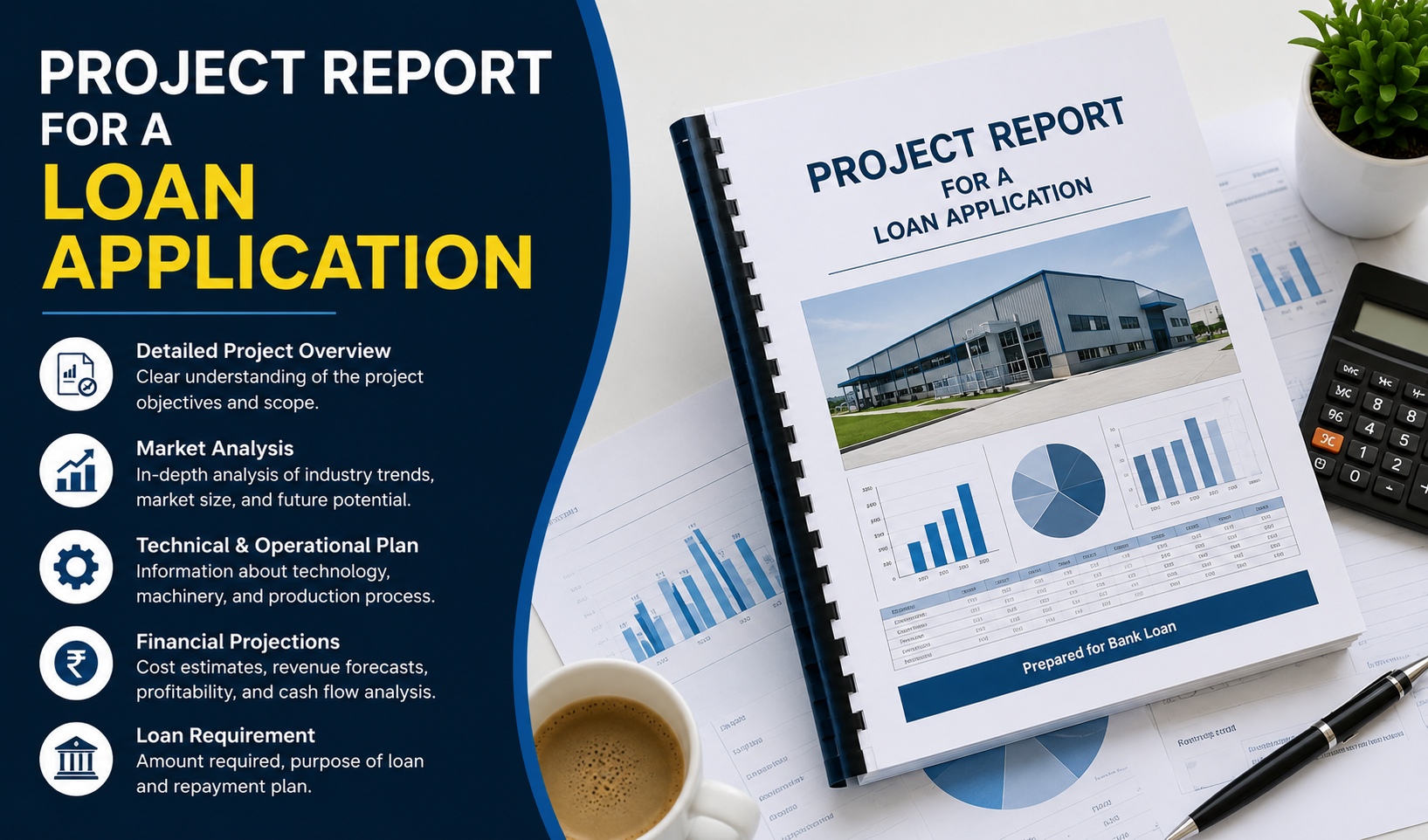
Importance of a Project Report for a Bank Loan
A Project Report for Bank Loan is the primary document reviewed by banks and financial institutions to judge the viability and risk of the proposal. It includes:
- Projected revenues and profits
- Required loan amount
- Usage of loan funds
- Business sustainability
- Repayment capability
Without a strong Detailed Project Report, loan sanction becomes difficult. This is especially true for schemes like the PMEGP Project Report (for rural and unemployed entrepreneurs), the CMEGP Project Report (a state-level subsidy scheme), and the Mudra Loan Project Report (for micro and small enterprises).
Key Sections in a Detailed Project Report for Bank Loan
When creating a Detailed Project Report for a Bank Loan or a Feasibility Project Report, the following components must be included:
1. Executive Summary
An overview of the business, highlighting the key features of the proposal and loan requirements. This section sets the tone for the entire Project Report.
2. Promoter Profile
Details about the business owner(s), their qualifications, experience, and management capabilities. A solid profile adds credibility to any PMEGP Project Report, CMEGP Project Report, or Mudra Loan Project Report.
3. Business Overview
Detailed description of the business model, services or products offered, and their USP. A must-have for any type of Project Report for a Loan.
4. Market Analysis
Include industry trends, customer segmentation, competition, pricing strategy, and market potential. This helps in building a convincing Feasibility Report.
5. Technical and Operational Plan
Outline of infrastructure, location, machinery, manpower, and production process. This is crucial for preparing a Detailed Project Report for sectors such as manufacturing, food processing, or textiles.
6. Financial Projections
This is the most critical part of any Project Report for a Bank Loan:
- Estimated cost of the project
- Funding requirements and means of finance
- 5-year projections of Balance Sheet, P&L, and Cash Flow
- Break-even analysis
- Loan repayment schedule
These details are essential in the Mudra Loan Project Report, PMEGP Project Report, and Feasibility Project Report formats.
Differences Between Project Report and Feasibility Report
- A Project Report gives an overall plan and roadmap of your business.
- A Feasibility Report or Feasibility Project Report specifically focuses on whether the business idea is practical and financially sound.
Banks often require both, especially when evaluating larger loans under schemes like the Detailed Project Report for Bank Loan for new industrial units.
Tips to Prepare a Strong Project Report for a Loan
- Customize for the Loan Type
Each scheme (e.g., PMEGP, CMEGP, Mudra) has unique requirements. Tailor the Project Report accordingly. - Use Realistic Data
Don’t overestimate profits or underestimate costs. Your Feasibility Report must look practical. - Include Government Scheme Benefits
In your PMEGP Project Report or CMEGP Project Report, mention subsidy amounts, contribution percentage, and implementing agencies like KVIC or DIC. - Consult Financial Experts
Use Chartered Accountants or certified consultants to prepare a compliant Detailed Project Report. - Follow the Latest Guidelines
financial institutions will be more stringent. Update your Project Report for Bank Loan as per RBI and scheme-specific changes.
Common Mistakes to Avoid
- Using generic templates for every loan type
- Ignoring scheme-specific details in the PMEGP Project Report or the Mudra Loan Project Report
- Incomplete financial projections
- Missing the Feasibility Report altogether
- Submitting outdated formats not accepted by banks or implementing agencies
Conclusion
A well-drafted Project Report for a Loan is more than just a formal requirement—it’s the key to unlocking credit for your business. Whether you’re preparing a PMEGP Project Report, CMEGP Project Report, Mudra Loan Project Report, or a Detailed Project Report for Bank Loan, ensure it is realistic, data-backed, and aligned with the scheme or lender’s expectations.
Remember, a solid Feasibility Project Report or Feasibility Report adds weight and professionalism to your application, helping you stand out in a competitive funding environment.
Frequently Asked Questions
Q1. What makes a project report strong enough for bank loan approval?
A strong project report has five non-negotiable elements — a DSCR above 1.25 in every repayment year, financial statements that reconcile across all sections, realistic revenue projections backed by market data, CMA data in the exact RBI-prescribed format, and a repayment schedule that matches the bank’s actual lending rate and tenure. Missing or incorrect even one of these elements is enough for a credit officer to return the file.
Q2. How does a project report help in getting a bank loan approved?
A project report answers the three questions every bank credit officer must answer before recommending a loan — is the business technically and commercially viable, are the financial projections realistic, and can the promoter repay the loan from business earnings. A well-prepared CA-certified project report answers all three convincingly, moving your application from the return pile to the approval pile.
Q3. What financial information must a project report include?
A bankable project report must include a 5-year projected profit and loss account, balance sheet, and cash flow statement — all internally consistent. It must include CMA data with all 7 RBI-prescribed statements, DSCR calculation above 1.25, MPBF calculation under Tandon Committee method, break-even analysis, and a month-wise loan repayment schedule aligned to the bank’s specific lending rate.
Q4. How long should a project report for bank loan be?
A standard project report for loans up to Rs.25 lakh is typically 15 to 25 pages. A Detailed Project Report (DPR) for loans above Rs.25 lakh is 40 to 60 pages, including comprehensive market research, multi-scenario financial modelling, sensitivity analysis, and an implementation schedule. The length depends on loan size and the bank’s credit committee requirements.
Q5. Can a weak project report cause loan rejection even if I am eligible?
Yes. 60% or more of Indian bank loan applications for small businesses get delayed or rejected due to weak, incomplete, or copy-paste project reports — not because the business is ineligible. The most common causes are DSCR below 1.25, financial statement inconsistencies, unrealistic revenue projections, and wrong CMA format for the specific bank. Sharda Associates
Q6. What is the difference between a project report and a business plan?
A business plan is a strategic document written for internal planning or investor pitching — it focuses on the business vision, team, and growth strategy. A project report for a bank loan is a formal, CA-certified financial document prepared specifically for bank credit appraisal — with CMA data, DSCR, MPBF, and a repayment schedule in the bank’s prescribed format. Banks do not accept business plans as a substitute for project reports.
Q7. How many years of financial projections does a bank need in a project report?
Most banks require 5 years of projected financials — profit and loss, balance sheet, and cash flow. For working capital loans, 3 years of projections is often sufficient. For SIDBI and larger loans, banks may require projections covering the entire loan repayment tenure. Always confirm with your specific branch before preparing.
Q8. Does a project report need to be CA-certified?
Banks do not always explicitly mandate CA certification in their guidelines, but in practice most bank branches — particularly for loans above Rs.25 lakh — prefer or require CA-certified project reports. A CA-certified report carries significantly more credibility in credit appraisal because it signals that a qualified professional has verified the financial figures. Sharda Associates CA-certifies every project report before delivery.
Q9. How is a project report for PMEGP different from a regular bank loan project report?
PMEGP requires a project report in the specific KVIC or DIC format — not a standard bank loan format. The PMEGP report must include employment generation figures, category-specific subsidy calculation (15% to 35%), and a promoter contribution section showing the correct margin money percentage. The DIC committee evaluates the PMEGP project report before it reaches the bank. A standard bank loan format submitted for PMEGP will be rejected at DIC stage.