
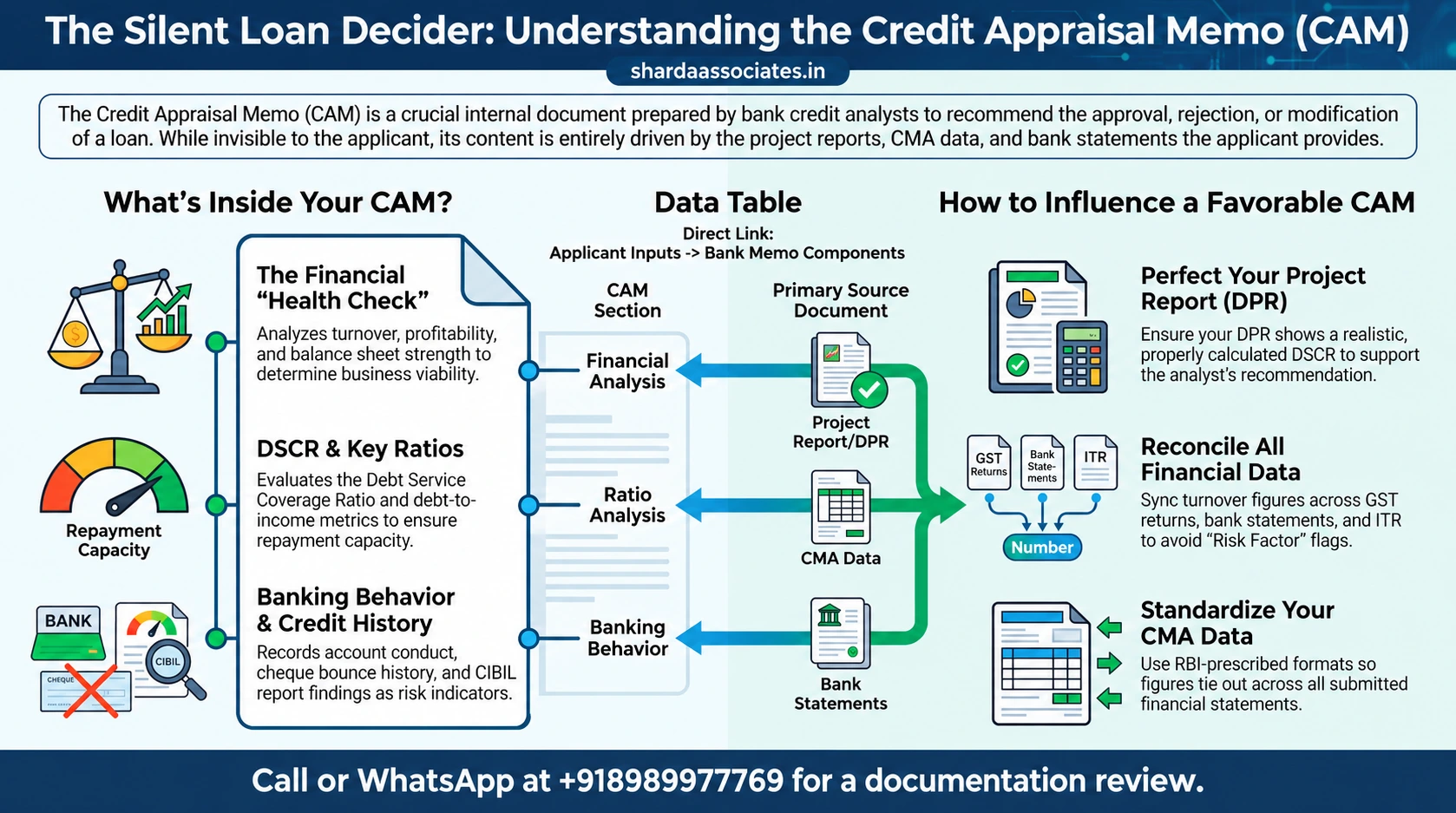
You’ll probably never see it, but there’s an internal document that decides more about your loan outcome than anything you submit directly — the Credit Appraisal Memo, or CAM. It’s the note a bank’s credit analyst prepares for the sanctioning authority, condensing your entire application — financials, credit history, collateral, risk factors — into a structured recommendation to approve, reject, or modify the loan. Since so much of what goes into a CAM comes directly from your project report, CMA data and bank statements, the quality of these source documents has a direct bearing on how the CAM ultimately reads.
At Sharda Associates, understanding exactly what a CAM needs is central to how we prepare project reports and CMA data — so here’s what a CAM actually is, what it contains, and why it matters more than most applicants realise.
What Is a CAM?
A Credit Appraisal Memo (also called a Credit Appraisal Memorandum, Credit Analysis Memorandum, or simply “credit memo” depending on the institution) is an internal document prepared by a bank’s or NBFC’s credit team to formally document their analysis of a loan proposal before it goes to the sanctioning authority or credit committee. It exists across loan types — business loans, MSME loans, working capital limits, loan against property, and corporate credit — and serves as the official record of why a lending decision was made the way it was.
What Does a CAM Typically Contain?
| Section | What It Covers |
| Borrower profile | Business background, promoter details, industry, and experience |
| Purpose of the loan | What the funds will be used for and how this fits the business plan |
| Financial analysis | Turnover, profitability, balance sheet strength, and trend over recent years |
| CMA data / project report analysis | Projected income, cash flow, and repayment schedule for term loans and new projects |
| DSCR and key ratios | Debt Service Coverage Ratio, TOL/TNW, debt-to-income, current ratio, and other risk metrics |
| Banking behaviour | Account conduct, turnover realisation, cheque bounce history, existing credit facilities |
| Credit history | CIBIL score and report findings, any negative remarks or defaults |
| Collateral and security | Valuation and adequacy of any collateral offered |
| Verification details | Findings from residence/business visits, reference checks with suppliers or bankers |
| Risk assessment | Identified risk factors and mitigants |
| Recommendation | The analyst’s proposed decision — approve, reject, or modify amount/terms — for the sanctioning authority |
How Banks Actually Use the CAM
- It’s the basis for the sanctioning decision. The branch manager, regional credit committee, or scheme authority reviewing your file typically relies on the CAM rather than re-examining every raw document themselves.
- It documents the “why” behind the decision. Whether your loan is approved, rejected, or reduced, the CAM records the analyst’s reasoning — this is also what internal audit and regulators may review later.
- It shapes the loan structure, not just the yes/no. The CAM’s recommendations directly influence the sanctioned amount, tenure, interest rate, and any conditions attached to the loan.
- It’s a risk-management tool. By requiring a structured, documented rationale for every credit decision, the CAM process is one of the ways banks manage and reduce the chance of future loan defaults (NPAs).
- It becomes part of your credit file for renewals. For working capital and other renewable facilities, the previous CAM is often referenced when the credit team reviews the next renewal or enhancement request.
Why This Matters to You as an Applicant
You never see or submit the CAM directly — but everything in it comes from documents you do control:
- Your project report or DPR feeds directly into the financial analysis and DSCR sections.
- Your CMA data feeds the ratio analysis and financial trend commentary.
- Your bank statements shape the “banking behaviour” section.
- Your credit report determines the credit history section.
- The site visit (where conducted) populates the verification section.
If any of these source documents are inconsistent, generic, or don’t reconcile with each other, the analyst preparing the CAM either has to raise queries (delaying your file) or record the inconsistency as a risk factor (potentially reducing or rejecting the sanction). A well-prepared, internally consistent set of documents makes it easier for the analyst to write a CAM that supports a favourable, well-structured recommendation.
How to Indirectly Strengthen Your CAM
Since you can’t write or influence the CAM directly, focus on the inputs that feed it:
- Ensure your project report/DPR shows a realistic, properly calculated DSCR.
- Reconcile turnover figures across GST returns, bank statements, and ITR before submission.
- Keep your CMA data in the standard RBI-prescribed format, with figures that tie out across statements.
- Maintain clean banking behaviour — regular transactions, no cheque bounces, consistent balances.
- Be prepared and available for any verification visit, since this section directly informs the analyst’s risk assessment.
Conclusion
You’ll never fill out a CAM yourself, but you influence almost everything that goes into one — your project report, CMA data, bank statements, and credit history. The more internally consistent and realistic these are, the easier it is for a credit analyst to write a CAM that supports approval on good terms. Our CA team at Sharda Associates prepares project reports and CMA data specifically built to hold up under this kind of internal scrutiny. Call or WhatsApp us at +918989977769 for a review of your documentation before it reaches the bank’s credit desk.
Frequently Asked Questions
1. Can I see or request a copy of my CAM?
Generally no — the CAM is an internal document for the bank’s credit process, though you can typically request the reason for a rejection or reduced sanction separately.
2. Is a CAM prepared for every type of loan?
Yes, in some form — CAM (or an equivalent internal appraisal note) is used across business loans, MSME loans, home loans, working capital limits, and corporate credit, though the depth of analysis varies with loan size and complexity.
3. Does a CAM decide the loan amount, or just approve/reject?
Both — the CAM’s analysis and recommendation typically shape the sanctioned amount, tenure and terms, not just a binary approval decision.
4. How is CMA data related to the CAM?
CMA data is one of the key financial inputs the credit analyst uses to build the financial analysis and ratio sections of the CAM, particularly for term loans and working capital limits.
5. Who prepares the CAM?
It’s prepared by the bank’s or NBFC’s credit analyst or underwriter, then submitted to the branch manager, regional credit committee, or relevant sanctioning authority for a decision.
6. Can a well-prepared project report improve my chances at the CAM stage?
Yes — a realistic, properly reconciled project report gives the analyst cleaner, more defensible data to work with, which generally supports a stronger recommendation.
7. Is the CAM used again if I ask for a loan renewal or enhancement?
Often yes — for renewable facilities, the previous CAM and its findings are typically referenced when the credit team reviews your next renewal or enhancement request.
8. Does the CAM include the findings from a bank’s site visit?
Yes — verification details, including physical visit findings and reference checks, are typically recorded as part of the CAM.
9. Can errors in my documents show up as risk factors in the CAM?
Yes — inconsistencies between your GST returns, bank statements, and application figures are exactly the kind of issue an analyst is trained to flag in the risk assessment section.
10. Is CAM the same across all banks?
The core purpose and most sections are similar, but the exact format, terminology (Credit Appraisal Memorandum vs. Credit Analysis Memorandum), and depth of detail vary by institution.