
If your loan got sanctioned weeks ago and the subsidy still hasn’t turned up, you’re probably assuming something has gone wrong somewhere in your file. In most cases, nothing has. This is one of the most common points of confusion for anyone going through PMEGP or a similar scheme-linked loan, and it isn’t really about your eligibility or your project at all. It’s about a process most applicants are never actually walked through:
How a Government Subsidy claim gets filed, who is responsible for filing it, what conditions it has to meet before it’s validated, and what “receiving” the subsidy even means once it does come through.
At Sharda Associates, this is one of the questions we get asked most often right after a client’s loan is sanctioned, more often, honestly, than questions about the sanction itself, so it’s worth setting out clearly and completely how this actually works, where it genuinely can go wrong, and what you should be checking instead of just waiting.
First, What “Subsidy Not Received” Usually Actually Means
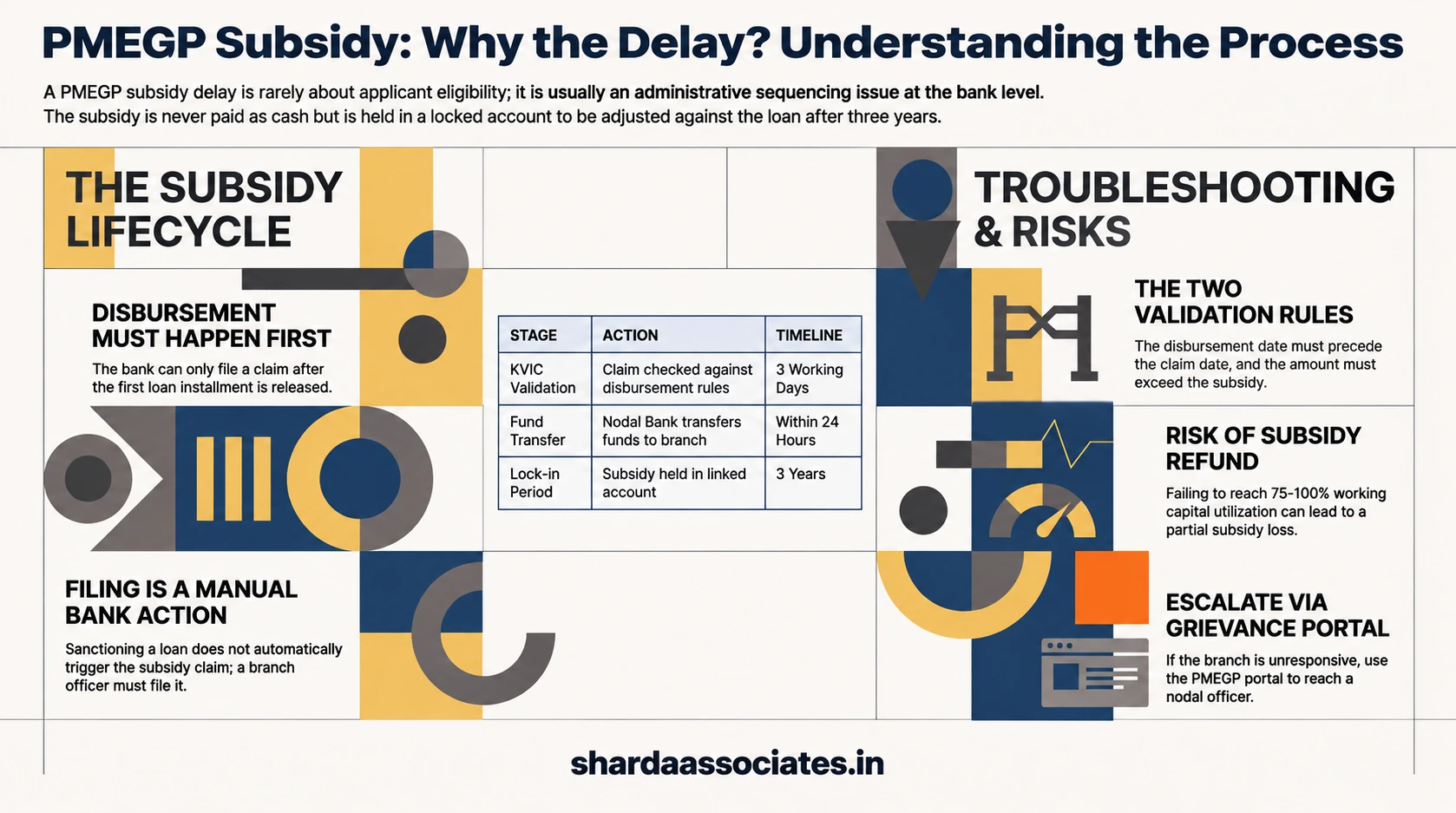
Here’s the part that trips up almost everyone. Under PMEGP and similar schemes, the subsidy was never meant to land in your hands as cash. It gets credited into a linked account held at your bank, kept there for a lock-in period, and adjusted against your loan later. If you were expecting a deposit into your own savings account, that’s not how this scheme works, and it never was.
This changes what you should actually be checking. The real question isn’t “why hasn’t the government sent me money.” It’s “has my bank correctly filed the claim, and has KVIC validated it.” If you’re still working out which kind of report or documentation your file actually needs at this stage, our comparison of project reports, DPRs, and CMA data is worth a quick read.
How the Claim Process Actually Works
Your bank, not you, is responsible for filing the Margin Money subsidy claim with KVIC. This only happens after your loan is sanctioned and the first installment has actually been disbursed.
| Stage | What Happens | Typical Timeline |
| Loan sanction | Bank approves and sanctions the loan | Varies by bank, no fixed government timeframe |
| First disbursement | Bank releases the first loan installment | Must happen before the claim is filed |
| Claim filed | Bank submits the Margin Money claim to KVIC | At the bank’s discretion, not automatic |
| KVIC validation | Claim checked against two specific conditions | Typically 3 working days |
| Fund transfer | Nodal Bank transfers validated amount to financing branch | Within 24 hours of validation |
| Lock-in period | Subsidy held in a linked account, not paid out | Generally 3 years |
| Final adjustment | Subsidy adjusted against your loan balance | End of lock-in, subject to utilisation |
KVIC validates a claim only if it meets two specific conditions: the date of the first disbursement must be earlier than the date the claim was filed, and the amount of that first installment must be more than the subsidy amount being claimed. Banks that handle project finance regularly tend to move through this faster, which is part of why understanding how banks verify and process project finance helps set realistic expectations here.
Where Delays Actually Happen
Most delays trace back to one of these points in the chain above, not to anything wrong with your original application.
- The bank simply hasn’t filed the claim yet. This is the most common cause by a wide margin.
- Loan sanction doesn’t automatically trigger a subsidy claim
- Someone at the branch has to manually submit it
- At busier branches, this step often gets deprioritised behind other work
- The claim didn’t meet KVIC’s two conditions.
- First disbursement happened after the claim was filed, or
- The disbursed amount was less than the subsidy being claimed
- Either issue is a timing problem at the bank’s end, not a reflection of your eligibility. If your application had a rocky path to sanction, it’s worth checking whether the reasons your case had trouble at the bank are still creating friction at this later stage too
- Documentation mismatches in the claim itself.
- Errors in account details, UTR references, or project cost figures
- KVIC tends to hold rather than reject these claims, so they can sit unresolved until someone notices
- This is exactly the kind of gap that shows up when the underlying project numbers weren’t reconciled properly from the start
- The account or branch setup isn’t right.
- A TDR or linked account opened incorrectly
- A branch transfer that happened mid-process
- Getting the right kind of project report prepared for your bank loan at the outset reduces how often these administrative mismatches happen in the first place
What Happens to the Subsidy Once It’s “Received”
Even once everything goes through correctly, the subsidy doesn’t become spendable cash for you. It sits in a linked account for a lock-in period, generally three years, and gets adjusted against your loan at the end of that period rather than handed over. Getting a clear picture of how this fits into your overall repayment is easier when your loan and its supporting documentation were properly reconciled from the point of sanction.
There’s a real risk worth knowing about here too.
- If working capital utilisation doesn’t reach the required threshold, generally close to 75 to 100% of the sanctioned limit, within the three-year lock-in period, the bank has to refund a proportionate part of the subsidy back to KVIC
- The same applies if actual capital and working capital expenditure ends up lower than what was sanctioned
- In both cases, part of a subsidy that was technically already “received” is lost
Keeping GST filings consistent with what the loan projected also matters here, since GST returns feed directly into how lenders assess ongoing eligibility.
What to Actually Do If It’s Genuinely Delayed
- Ask your branch specifically whether the claim has been filed, not just whether your loan is sanctioned. These are two separate steps, and branch staff don’t always volunteer that distinction unless asked directly.
- Use the PMEGP grievance portal if the branch isn’t giving a clear answer. The Ministry of MSME hasn’t set a fixed timeframe for this process, but complaints filed on the grievance portal are meant to reach the concerned nodal officer within 2 working days, which tends to move things faster than repeated branch visits alone.
- Keep your original documentation on hand. Holding on to your project report and financial workings through this stage helps, since any claim query from KVIC often comes back to the same cost figures and disbursement details that were in your original application.
Conclusion
A subsidy that hasn’t shown up after loan approval is, in the overwhelming majority of cases, a claim-filing or sequencing issue sitting somewhere at the bank’s end, not a sign that something is wrong with your eligibility, your project, or your original application.
The process itself is fairly mechanical once you know what it actually involves: your bank has to file a claim, that claim has to meet two specific conditions, KVIC has to validate it, and the amount then sits in a locked account rather than arriving as cash in hand. Knowing exactly where things stand, filed or not, validated or not, transferred or not, turns a vague, anxious wait into something concrete you can actually follow up on with your branch or through the grievance portal.
At Sharda Associates, we help clients track this entire chain through from sanction to final subsidy adjustment, because the paperwork trail matters just as much after approval as it did before it, and a subsidy that quietly gets held up or partially clawed back three years later is just as costly as one that never came through in the first place.
Call us at +91 89899 77769 or reach out through our contact form if your subsidy has been stuck for a while and you’d like someone to actually check where it stands.
Frequently Asked Questions
1. My PMEGP loan was sanctioned two months ago and I still haven’t seen the subsidy. Is something wrong? Not necessarily. Ask your bank specifically whether the Margin Money claim has been filed with KVIC, since sanction and claim filing are separate steps, and the second one doesn’t happen automatically.
2. Will the subsidy come directly to my bank account? No. It’s credited into a linked account held by your bank, kept there for a lock-in period, and adjusted against your loan later. It was never meant to be handed to you as cash.
3. What are the two conditions KVIC checks before validating a subsidy claim? The first disbursement date has to be earlier than the claim filing date, and the disbursed first installment amount has to be more than the subsidy amount claimed. If either fails, the claim won’t validate.
4. How long is the subsidy supposed to take once the claim is filed correctly? KVIC validation typically takes about 3 working days, followed by a transfer to your bank within 24 hours of that validation. If your bank has genuinely filed a correct claim, it shouldn’t take much longer than this.
5. Can I lose part of the subsidy even after it’s been credited? Yes. If your working capital utilisation doesn’t reach the required threshold, or your actual expenditure ends up lower than sanctioned, within the three-year lock-in period, a proportionate part of the subsidy has to be refunded to KVIC.
6. Who do I contact if my bank isn’t responding about the delay? File a complaint on the PMEGP grievance portal. It’s meant to reach the concerned nodal officer within 2 working days, which tends to get more traction than repeated branch visits.
7. Does a delayed subsidy affect my loan repayment in the meantime? Your EMI obligations continue as scheduled regardless of the subsidy’s status, since the subsidy is adjusted later, not used to reduce your immediate repayment.