
Almost every business loan application in India comes with the same standard request: the last 6 months of bank statements. It shows up so consistently across banks and NBFCs that most applicants stop questioning it and just submit whatever the portal asks for. But the number itself isn’t arbitrary, and understanding why a lender specifically wants six months, not three, not twelve, actually helps you prepare a stronger application rather than just a compliant one.
At Sharda Associates, we walk clients through exactly what a lender is going to read into this window before they even submit it, because the statement itself often tells a story the applicant didn’t realise they were telling. This piece breaks down what that six-month window is actually built to catch, why shorter or longer windows create different trade-offs, and what you can do to make sure yours reads the way you want it to.
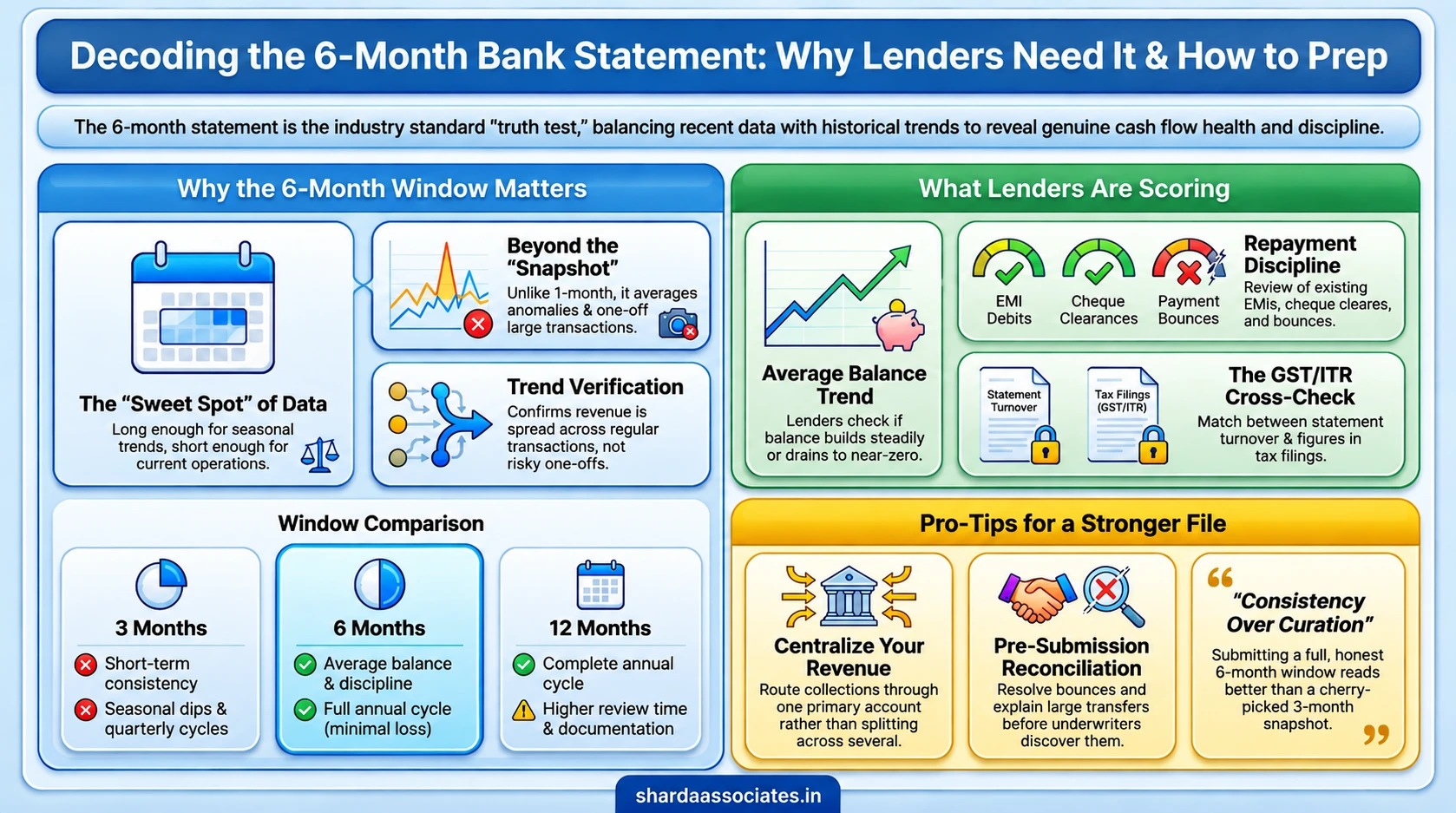
What Six Months Is Actually Built to Catch
A single month of banking activity tells a lender almost nothing reliable. It could be an unusually strong month, an unusually weak one, or a month with one large one-off transaction that skews the whole picture. Six months is roughly the shortest window that starts to average out these anomalies while still being recent enough to reflect how the business is actually running today, not how it was running a year and a half ago. This is part of why a properly reconciled bank loan report matters just as much as the statements themselves.
| Statement Window | What It Reliably Shows | What It Misses |
| 1 to 2 months | Current balance snapshot only | Almost everything about pattern or trend |
| 3 months | Basic short-term consistency | Seasonal dips, quarterly cycles |
| 6 months | Seasonal variation, average balance trend, repayment discipline | Full annual cycle for highly seasonal businesses |
| 12 months | Complete annual cycle, strongest long-term picture | Nothing significant, but slower to compile and review |
Six months sits in the middle for a reason. It’s long enough to be meaningful, short enough to not slow down the process for a routine loan.
The Specific Things a Lender Is Checking Across The Bank Statements
- Average balance trend. Whether your balance builds steadily and dips modestly, or spikes once and drains to near zero every cycle.
- Seasonal variation, without demanding a full year. Six months is usually enough to catch at least one dip or slow patch, which tells a lender more than a suspiciously smooth three-month window ever could.
- A business that only shows its best quarter looks stronger on paper than one that’s honestly showing a slower month too
- Lenders are specifically wary of applicants who submit a cherry-picked window
- Repayment discipline. Existing EMI debits, cheque clearances, and whether any of them bounced.
- Deposit consistency versus concentration. Whether revenue is spread across regular transactions or concentrated in one or two large, possibly one-off credits.
- Recency. Unlike a year-old financial statement, six months of statements are recent enough that the lender isn’t making a decision based on outdated information. A CMA report built on stale figures loses exactly this advantage.
Why Not Just Ask for 3 Months, or 12?
Three months is genuinely too short for most lending decisions. It’s easy to make three months look clean, intentionally or not, and it simply doesn’t have room to show a seasonal dip or a slow patch, which is often the most useful thing a lender can see. Some smaller unsecured or fintech products do use a 3-month window, but they usually compensate with a higher rate or a smaller ticket size to offset the reduced visibility. This is one of the reasons a clear project report vs DPR vs CMA comparison matters, since different products lean on different combinations of these documents to make up for a shorter statement window.
Twelve months, on the other hand, gives a stronger picture but comes at a real cost. It takes longer to review, it’s a heavier documentation ask for the applicant, and for most standard-sized loans it doesn’t actually change the credit decision enough to justify the extra time. Twelve months tends to get requested specifically for larger term loans, for genuinely seasonal businesses where a shorter window would miss an entire cycle, or where project finance verification requires deeper diligence anyway.
Six months is the practical middle ground: enough data to catch the patterns that matter, without the overhead of a full year.
How This Connects to the Rest of Your Application
Your bank statement isn’t reviewed in isolation. Lenders routinely cross-check it against your GST filings and your income tax returns, and a mismatch between what your statement shows and what your GST returns report is one of the more common reasons a file gets flagged for a closer look.
This is also why the six-month statement matters even when you already have a strong project report or CMA data prepared. Projections describe what you expect to happen. The statement describes what has actually been happening, and a lender weighs both together rather than accepting one in place of the other. If your file has run into trouble at appraisal before, it’s worth checking whether inconsistencies flagged after a bank objection trace back to exactly this kind of mismatch.
How to Make Sure Your Six Months Reads Well
- Route collections through one primary account rather than splitting activity across several accounts with no clear pattern.
- Resolve any bounced cheques or returned mandates before applying, and be ready to explain any that remain on record.
- Avoid large, unexplained transfers close to your application date. These draw immediate attention precisely because they look timed to the application.
- Reconcile your statement-visible turnover against GST and ITR figures before submission, so any gap is something you can explain rather than something the underwriter discovers first.
- Don’t try to submit a curated three-month window if your lender asks for six. Submitting exactly what’s asked, including a weaker month if there is one, generally reads better than an application that looks selectively edited.
Conclusion
Six months isn’t a bureaucratic default; it’s the shortest window that reliably separates a business with genuine, steady cash flow from one that just happens to look good in a snapshot. It’s long enough to catch a seasonal dip, a pattern of bounced payments, or a concentration of revenue in one unusual month, and short enough that it doesn’t turn a routine loan application into a year-long documentation exercise. Once you understand what a lender is actually reading for across that period, average balance trend, seasonal variation, repayment discipline, and consistency with your GST and ITR figures, preparing for it stops being a paperwork chore and becomes something you can actually get ahead of.
At Sharda Associates, we help clients review this exact pattern before it ever reaches a bank, along with the CMA data and project reports that sit alongside it, so the full picture works in the applicant’s favour rather than against them. Call us at +91 89899 77769 or reach out through our contact form to get your documentation reviewed before you apply.
FAQs
1. Why do banks specifically ask for 6 months and not 3 or 12? Six months is long enough to catch seasonal dips and average out one-off anomalies, but short enough to review quickly. Three months is often too easy to curate, while twelve months adds documentation burden without changing most standard loan decisions.
2. Does a strong recent month make up for a weak one earlier in the six-month window? Not entirely. Lenders are looking at the overall trend and consistency, not just the most recent figure, so a single strong month doesn’t offset a pattern of instability across the rest of the window.
3. Can I submit statements from an account I don’t use for most transactions? This usually backfires. If your real activity is spread across multiple accounts, submitting only your cleanest one raises questions when it’s cross-checked against your GST or ITR figures, which reflect your full business activity.
4. What if my business is genuinely seasonal and six months looks weak? Say so directly, and consider providing twelve months instead if the lender allows it, so the full cycle is visible rather than just the slower half of it.
5. Do NBFCs and fintech lenders use the same 6-month standard as banks? Not always. Some work with as little as 3 months for smaller unsecured loans, though this is often paired with tighter pricing or lower loan amounts to offset the shorter visibility window.
6. Will bounced cheques from several months ago still count against me? Often yes, especially if there’s a recurring pattern rather than a single, resolved instance. A cleared, well-explained bounce is treated very differently from repeated ones.
7. Does the 6-month statement matter if I already have a strong project report? Yes. A project report shows projections; the bank statement shows what has actually happened. Lenders weigh both, and a strong report doesn’t offset a concerning banking pattern.